

arts&life
music
Jeffrey Grossman and his
group make high-energy at
home with chamber music.
High
Voltage
SUZANNE CHESSLER CONTRIBUTING WRITER
J
“I took some harpsichord lessons and
found something intoxicating about
the way the instrument itself spoke. It
has an immediacy when it’s played well
that gives it a lightness and flavor so
that I couldn’t get enough of it.”
— JEFFREY GROSSMAN
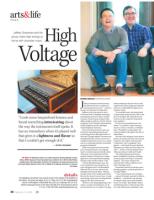
TOP RIGHT: The Sebastians: Daniel S. Lee, Jeffrey Grossman, Nicholas DiEugenio and Ezra
Seltzer. ABOVE: Grossman’s French harpsichord was crafted for him in 2016 by Allan Winkler,
considered one of the best builders in America. The instument is an almost exact copy of one
by François-Étienne Blanchet II from 1765. In addition to its elaborate decoration, it is voiced in
bird feather.
details
The Sebastians will perform two concerts as part of the season of the Academy of
Early Music. The group will appear at 8 p.m. Friday, Feb. 23, at the Congregational
Church of Birmingham in Bloomfield Hills, and 8 p.m. Saturday, Feb. 24, at St.
Andrew’s Episcopal Church in Ann Arbor. $10-$35. Pre-concert lectures start at
7:15 p.m. (734) 228-4338; academyofearlymusic.org.
30
February 15 • 2018
jn
effrey Grossman’s musical journey
has allowed for him to experience
instrumental time travel — and he is
loving every direction it’s taken him.
Eighteen years have gone by since
Grossman lived in Michigan and began
pursuing his passion for piano and per-
cussions. Private lessons enhanced his
skills enough to perform with the Detroit
Symphony Civic Orchestra, Metropolitan
Youth Symphony and the Michigan
Youth Symphony Orchestra.
Time away from his home state was
devoted to expanding keyboard and
conducting prowess through studies at
Harvard, Carnegie Mellon University and
the Julliard School, and he moved on to
notable professional concerts as a soloist
and as a continuing member of chamber
group the Sebastians.
While moving forward in his profes-
sion, Grossman found a way of going
back to instrumental and melodic styles
of the past. As he performed with his
quartet, audiences listened to a unique
approach to the harpsichord featuring
baroque music (written before 1750).
“I always liked listening to jazz, but
I never studied it,” says Grossman, 35,
who will appear Feb. 23 in Bloomfield
Hills and Feb. 24 in Ann Arbor for his
Michigan professional debut. “Playing
baroque music with a really good ensem-
ble was the closest I came to jazz. I could
make things up because the harpsichord
supports the other instruments.
“If there’s a fun thing happening on the
violin, I can play something fun, too. If
the instruments are very quiet, I can play
almost nothing at all and come in with
a big flourish when things get totally dif-
ferent in a totally different approach to
chamber music.
“In ensemble music, the harpsichord
is improvising along with the cello or the
bass. In baroque, the harpsichord sort
of serves as the conductor tying all the
parts together. “
In the two local performances, the
theme, “Les Nations,” relates baroque
music to what is currently a worldwide
issue. Through the compositions, the
instrumentalists will explore the idea of
nationalism.
The title of the program comes from a
project of sonatas and suites by Francois
Couperin, who will be represented by
“L’imperiale” and “L’espagnole.” Also
played — with Daniel Lee and Nicholas
DiEugenio on violins and Ezra Seltzer on
cello — will be works by Handel, Royer,
Telemann, Mossi, Corelli and Vivaldi.
“We will be playing music from a
bunch of different countries, including
Germany, Italy and France,” Grossman
explains. “The music will have the
national styles of those different coun-
tries in baroque times.”
Grossman’s interest in baroque came
through graduate conducting studies at
Carnegie Mellon.
“I was conducting all sorts of things
— operas by Rossini, musicals by Marvin
Hamlisch — and found I was missing
an intimacy that comes with chamber
music,” he recalls. “Specifically, I found
myself being drawn to the baroque rhet-
oric with instruments speaking to each