

camp guide
continued from page 36
LIFE’S WORK
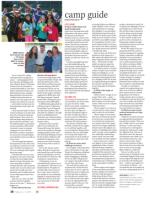
ABOVE: Welcome
Home, Tamarack-style
… “The Greatest
Place on Earth!”
RIGHT: The Trepecks:
Jamie, Lee, Andy
and Robin.
At 18, I went off to college
and forgot about camping as a
career — earning degrees from
the University of Michigan and
Case Western Reserve University
School of Law in Cleveland; I
worked only briefly in a law firm
before I joined the business my
father had started as a Burger
King franchisee. We thrived as
a family business because we
shared a love and respect for one
another and a desire to succeed
— all of which was born out of a
deep admiration and respect for
our dad.
I often say how lucky I’ve been:
I loved working in a law firm and
loved the restaurant and hospi-
tality business. Then, when we
sold our Burger King business, I
got involved in real estate. I was
29, professionally in a good place
and yet, passively, I still wanted
to pursue a career in summer
camping. So, I met with Neil
Schechter, a former camp direc-
tor and owner of Camp Walden,
and asked him what it was like to
run a camp.
I’ll never forget his response.
He leaned back in his chair, took
out a Kleenex, started to cry and
said, “You’ll have to forgive me;
I’m very emotional when I speak
about my camp.”
I told him that I was at a turn-
ing point in my career, not ready
to write the next chapter. But I
shared my hope that at the end
of my story there would be a
moment like this, when someone
would come to me for advice and
ask me how I made my career
decisions, and I would be moved
to tears that express that I have
chosen well.
And now, as I enter my 10th
summer, this job regularly
moves me to tears — always in a
happy way.
Q: How did you become
38
February 1 • 2018
director of Camp Maas?
I started a bowling league with
my good friend Brian Siegel. Talk
about Jewish Detroit connec-
tions! I first met Brian (now the
executive director of the JCC)
at Camp Sea-Gull; he was my
counselor. We needed one more
bowler in the league, and Brian
suggested we fill the spot with
this “great camp guy” named
Jonah Geller (Tamarack’s execu-
tive director from 2000-2008).
In 2008, Jonah approached me
with the prospect of directing
Camp Maas. I was 40, happy in
the real estate business, mar-
ried with two children. I thought
Jonah was kidding because
Tamarack was running a nation-
al search and was close to final-
izing its choice.
Long story short, I got the
offer. It was a bold move for
Tamarack because the typical
route to the position is through
camping program work, assis-
tant directing, building a resumé
for the position of director. My
professional experience with
camp was zero, but Tamarack
took the leap with me and I’m
grateful.
Now at the 10-year mark, I
believe that all of my previous
roles benefit the work I’m doing
today. It’s gratifying to see how
all my paths now intersect with
running our camp business.
At Tamarack, we are an
extended family. I always say to
our employees, “Welcome to our
family business.” We gather at
a family table, where each one
has a voice. And we stand by
one another at our community
flagpole. It sounds funny, but I
truly believe the sun rises and
sets somewhere in Ortonville
every day.
ON FAMILY, MARRIAGE AND
jn
Q: Share a little about your
family background.
I grew up in a loving home with
both parents. My mom worked
for 20 years at the Detroit
Institute of Arts as a docent; she
was an expert in history and kept
our family involved in arts and
culture. My dad was a business
entrepreneur, and together my
parents taught us the values of
hard work, discipline and com-
mitment. My sister is in Chicago;
my brother lives here; and our
families are still very closely con-
nected.
I’m also especially lucky that
my wife’s family follows the
same pattern. Robin (Kaufman)
grew up with two loving par-
ents whom I am very close to.
As many people in the com-
munity know, Scott Kaufman,
Federation’s CEO, is my brother-
in-law. The Kaufman-Trepeck
family relationships go back to
our parents and our grandpar-
ents — three generations! Our
grandparents also shared the
same circle of friends throughout
their adult lives.
ON CAMP LIFE
The summer at Tamarack is its
own marathon. You never sleep;
you pass out with a walkie-
talkie in your hand, a cell phone
at your bedside, a land line,
the door open, the lights on.
You doze through the night in
the state of ready alert. That’s
because you have 1,000 kids at
camp under your supervision
and about 350 staff members.
We operate a business that
feels like a family. We live togeth-
er, we celebrate together, and
we work together. Being a father
raising my own son and daugh-
ter at camp both inspires me
and grounds me to the depth of
conversations I often have with
parents.
Q: What are some of the
challenges you have?
It’s a tougher world today than
when I started just 10 years ago.
There’s the ubiquitous cell phone
and there’s social media that
makes unplugging a challenge.
We do not allow cell phone for
our campers; but staff members
can use them after hours.
We work hard to enforce the
no-phone rule. At first the kids
resist it. But we say it’s a gift. We
tell kids they may not appreciate
it at first, but they are going to
love this gift every minute they
are in camp because, like explor-
ers, they are signing off for the
summer, about to discover “the
Greatest Place on Earth.”
And for parents, the challenges
of raising children are different
today. Children come to camp
with medications to manage,
food allergies to accommodate,
individual and special needs of
all kinds. It’s all just a part of the
make-up of our summer, and we
are able to successfully navigate
the complexities. We have a tal-
ented medical staff: two doctors,
four nurses, four clinic assistants,
two charge nurses and a director
of health and safety.
And yes, there are all the food
preferences that require us to
offer options for gluten-free, non-
dairy, vegetarian, kosher, special
diets — all beyond our daily
salad bar, soup bar, pasta bar
and typical kid-friendly meals.
As a staff, we know we need to
analyze complex issues and hire
talent accordingly. So, we are
staffed intentionally focused on
preparing young people to lead
in a changing world. We do that
by ongoing training, throughout
the summer and off-season,
never losing sight of having fun
together.
Q: What is the magic of
Tamarack?
I believe there’s a magic in our
energy. That ruach — spirit —
that keeps us connected. I think
there’s magic in our buzzword
“home,” when we say to campers,
“Welcome Home.”
There’s magic in our voices as
we raise them in song, in prayer
and in cheers for one another.
There’s magic in the remark-
able story of Tamarack’s growth
in recent years, a master plan
at work that has transformed
our campus. Since Steve Engel
arrived, we’ve begun significant
enhancements throughout our
campus. In buildings and activity
areas, we enjoy a new amphithe-
ater, staff lodge, staff housing,
nature center, arts and crafts
area, medical and clinic updates
— just to name a few. And, in
our villages, we have rebuilt
Applebaum, DeRoy, Charach
Sheruth, Berman, Kaufman
Specialty, and Hermelin (to be
completed this summer). These
investments represent $12 mil-
lion in a conscientious, inten-
tionally planned progression of
community space, infrastructure
needs and program modifica-
tions.
There’s magic in the support
of our community, the leaders,
funders, families and volunteers
who have built this agency. I
think about all those I have
worked with and our common
passion and relentless desire to
provide a Jewish camping experi-
ence in a safe and happy place
for our children and to accom-
modate a diversity of needs. We
recognize the challenges some of
our families face in their home
life, and that camp is expensive
and not always easy for people
provide for their children. But
we have experts in place and
partners in the community to
help people navigate through
our financial resources and emo-
tional support system.
There’s the magic of our pro-
gramming itself. Our artist-in-
residence program, for example,
brings in specialists in different
disciplines to accommodate a
wide range of individual inter-
ests as well as group dynamics.
Our rabbi in residence, Rabbi
Ben Shalva, has added a won-
derful dimension to our Jewish
program through music, stories
and spiritual education. And,
finally, there’s magic in our Israeli
Camper Program, a longtime
partnership with the Jewish
Federation that continues to this
day to build our extended family.
Overall, we work hard to
expand our programming, year-
after-year, so that our children
grow step-by-step in a natural
progression from 10-day to
24-day sessions, then to extend-
ed wilderness trips Up North and
out west to Alaska and, finally, a
trip to Israel for our counselors-
in-training in partnership with
the community teen mission.
Q: What are some of your
sweetest memories as Camp
Maas director?
I think the sweetest memories
are appropriately pushing kids
beyond their comfort. That’s our
job. A child comes to us at times
and says, “I want to go home.”
And instead we work together
and partner with parents to get
the child past that. And out of
that effort comes the sheer joy
of seeing that same child cry on
the last day because he or she
doesn’t want to leave. That’s
the sweetest moment; it’s like a
ticket to the front row of the best
show in town to see the high-
lights unfold in a child’s life.
And, as I so often say, the
sweetest spot at Tamarack is the
community flagpole where every
season begins with high-five hel-
los and ends with tearful good-
byes — until we meet again. For
us, it’s always “L’hitraot — see
you again for the next chapter of
our never-ending family story.” •
Vivian Henoch is editor of
myjewishdetroit.org, where a longer
version of this story first appeared. To
watch Lee Trepeck’s recent Berman
Award acceptance speech, go to
bit.ly/2nmNInX.