

S omething
Borrowed
STACY GITTLEMAN CONTRIBUTING WRITER
How couples incorporate
treasured objects — from
treasured loved ones —
into their nuptials.
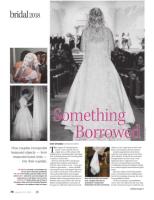
TOP CENTER: Amy Brody’s 10-foot Belgian-lace
veil was worn by the bride’s grandmother.
TOP LEFT: At her wedding, Julie Bass Sidder wore her
mother’s veil — made by the same lace designer who
created the lace on the bodice of her own dress.
BOTTOM LEFT: Mushky Dubvov had the honor of
borrowing a siddur used by the late Rebbe Menachem
Schneerson in her wedding to Rabbi Levi Dubvov.
T
he custom of “something bor-
rowed” is not a Jewish one. Its
origins lie in a 19th-century Old
English poem: Something Olde, Something
New, Something Borrowed, Something Blue,
A Sixpence in your Shoe.
However, Jewish brides and grooms
adapted this tradition and melded it
with the value of l’dor va dor — from gen-
eration to generation — when carefully
selecting the most meaningful objects to
use in their ceremonies. From heirloom
veils and handkerchiefs and chuppot
sewn from lace tablecloths that adorned
Shabbat tables from generations past to
Kiddush cups used to bless the wine by
fathers and grandfathers, memories of
the past are reflected in these borrowed
Marla and Vince Sallan were married
under a chuppah made from her
grandmothers’ monogrammed
handkerchiefs and other lacy heirlooms.
objects as the couple look to their own
future of carrying on Jewish customs.
Another popular borrowed item is
using the same gold ring worn by other
close relatives, if only for the ceremony.
Though brides can later wear a wed-
ding band that is engraved or jew-
eled, the ceremonial band according
to Kabbalah and Jewish tradition should
be an uninterrupted and unadorned gold
band.
Julie Bass Sidder of West Bloomfield
wears a jeweled eternity wedding band;
but for her wedding ceremony, she wore
her grandfather’s band.
“At the last minute, my grandfather,
who is now 102, offered me his own ring
for the ceremony because I could not use
continued on page 72
70
January 25 • 2018
jn
PHOTO BY SHAY SPANIOLA
bridal 2018