

arts&life
film
The
Number on
Great-Grandpa’s Arm
An Auschwitz survivor tells his great-grandson about his happy childhood in Poland,
the loss of his family and fi nding a new life in America in a new Holocaust documentary for kids.
BARBARA LEWIS CONTRIBUTING WRITER
I
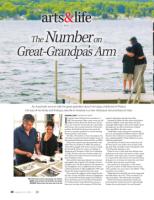
TOP: Elliott Saiontz with his great-poppy Jack Feldman.
ABOVE: Artist Jeff Scher with filmmaker Amy Schatz.
OPPOSITE: Stills by Scher that were used in the film.
38
January 25 • 2018
jn
t started when Sheila Nevins, president of
HBO Documentary Films, came across an old
children’s book about the Holocaust. Nevins
knew she wanted to use the idea for a short film.
And Nevins, who recently retired at 78 from the
position she’d held for 38 years, knew just the
person to produce and direct it: award-winning
documentarian Amy Schatz.
The film, The Number on Great-Grandpa’s Arm,
will make its national television debut on Jan. 27,
International Holocaust Memorial Day, on HBO.
Schatz has created many documentaries and
other films for children for HBO. Her projects,
which often grapple with serious issues, include
the Saving My Tomorrow series, An Apology to
Elephants and Through a Child’s Eyes: September
11, 2001. She has won seven Emmy awards, five
DGA (Directors Guild of America) awards and
three Peabody awards.
Shatz and her team spent almost two years put-
ting together the 19-minute The Number on Great-
Grandpa’s Arm. The film is based on The Number on
My Grandfather’s Arm, a children’s book of histori-
cal fiction by David A. Adler, published in 1987, said
Schatz. But Nevins wanted to tell a true story.
In her search for subjects, Schatz found the per-
fect pair: 10-year-old Elliott Saiontz of Chappaqua,
N.Y., and his beloved “great-poppy,” Jack Feldman,
90, an Auschwitz survivor who lives in Rochester,
N.Y. Schatz and her team filmed their conversa-
tions over two days in the summer of 2016, then
expertly edited them into the short film.
Narrated by Elliott, the film starts with photos
of Jewish children in the days before the Nazi
onslaught. Elliott talks to Jack, born Srulek, about
his happy pre-war life in Sosnoweicz, Poland.
Then, says Elliott, the Nazis came.
“Adolf Hitler made a big speech and said the
Jews are causing all the problems and if we kill all
the Jews then we’ll have no more problems,” he
says, explaining Hitler’s Final Solution in terms a
child can understand.
Jack tells how he had to leave school, how all
the Jews had to wear yellow stars on their cloth-
ing, and what it was like to live in the ghetto, with
15 or 20 people sharing a room.
When he was 14, Jack and some friends were
picked up on the street and sent to a labor camp.
His father, a hat maker, got a friend to smuggle
in a cap for him with money sewn into the band.
Jack gave it to a German in return for extra food;
he thinks that may have saved his life.
Jack ended up at Auschwitz in 1944, where
he got the number A17606 tattooed on his arm.
“Your number was your name,” says Elliott. “That
was all he was to them.”
Elliott learns how hard life was in the camps and
how little there was to eat. “Were you skinny?” he
asks. Jack replies, “My whole body was skinny!”
When the Germans abandoned Auschwitz,
Jack joined the inmates forced to walk through
Europe for several months. He was liberated