
arts&life
on the cover
Building Bridges
B
arbara Kratchman, active in many organizations
throughout the Jewish community, and Mary
Romaya, active in many organizations throughout
the Chaldean community, grew up in the same northwest
Detroit neighborhood.
They rode their bikes along the same blocks, near
Seven Mile and Livernois, and they frequented the same
stores and restaurants along what was known in the
1960s as the Avenue of Fashion along Livernois. Because
they didn’t go to the same schools, the two believe, they
never met as youngsters.
As adults, the two met through the Chaldean/Jewish
Building Bridges Initiative, established by the Detroit
Jewish News and the Chaldean News, and they became
friends serving as co-chairs of the Arts and Culture
Committee of that group.
The women got together informally and talked about
their efforts together, and they shared information about
special projects in each of their respective cultural com-
munities. Kratchman took a deep interest in a museum
A new museum traces 5,000 years
of Chaldean history — pointing out
connections to Judaism and forming
friendships along the way.
SUZANNE CHESSLER CONTRIBUTING WRITER
BRETT MOUNTAIN PHOTOGRAPHER
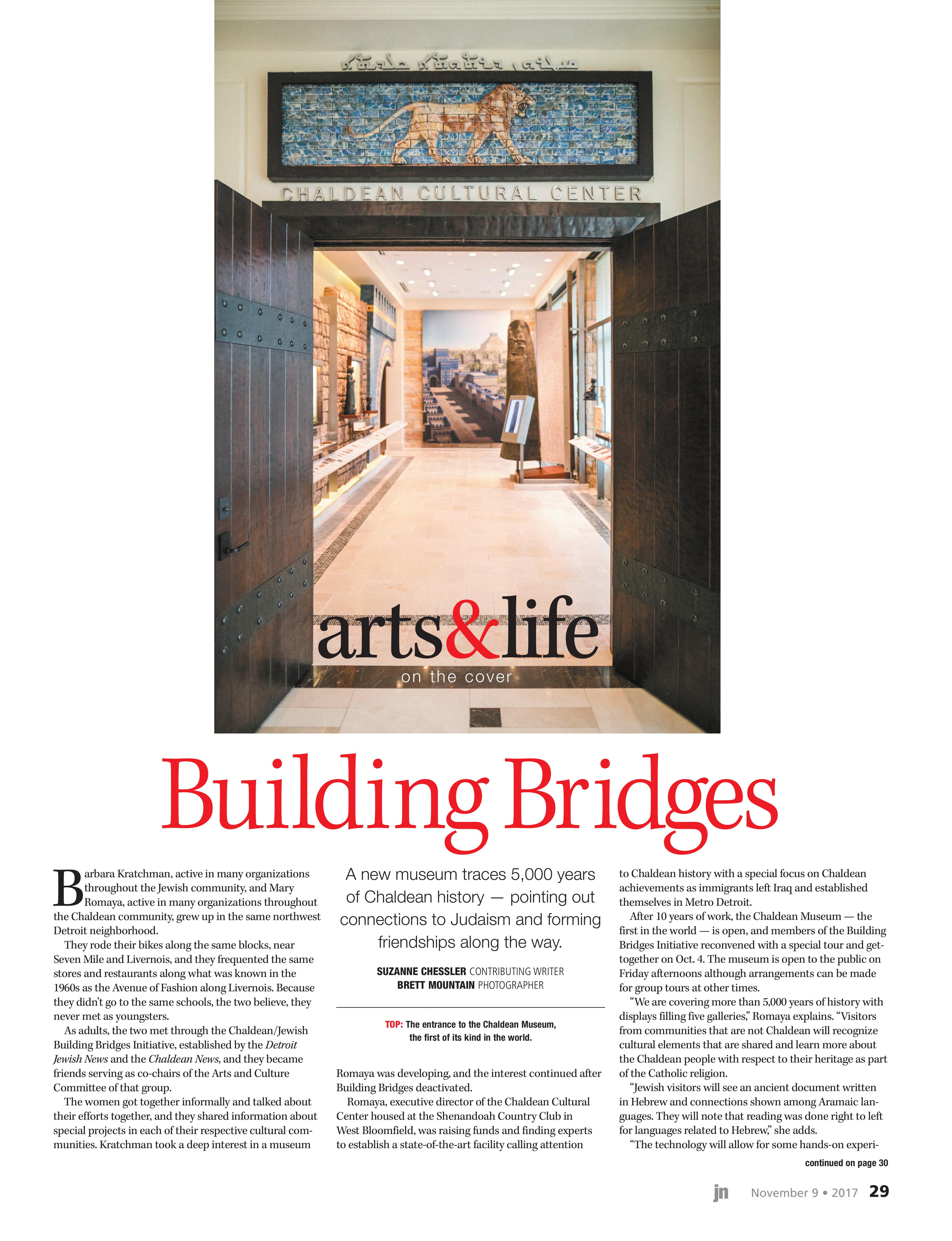
TOP: The entrance to the Chaldean Museum,
the first of its kind in the world.
Romaya was developing, and the interest continued after
Building Bridges deactivated.
Romaya, executive director of the Chaldean Cultural
Center housed at the Shenandoah Country Club in
West Bloomfield, was raising funds and finding experts
to establish a state-of-the-art facility calling attention
to Chaldean history with a special focus on Chaldean
achievements as immigrants left Iraq and established
themselves in Metro Detroit.
After 10 years of work, the Chaldean Museum — the
first in the world — is open, and members of the Building
Bridges Initiative reconvened with a special tour and get-
together on Oct. 4. The museum is open to the public on
Friday afternoons although arrangements can be made
for group tours at other times.
“We are covering more than 5,000 years of history with
displays filling five galleries,” Romaya explains. “Visitors
from communities that are not Chaldean will recognize
cultural elements that are shared and learn more about
the Chaldean people with respect to their heritage as part
of the Catholic religion.
“Jewish visitors will see an ancient document written
in Hebrew and connections shown among Aramaic lan-
guages. They will note that reading was done right to left
for languages related to Hebrew,” she adds.
“The technology will allow for some hands-on experi-
continued on page 30
jn
November 9 • 2017
29