

looking back
From the DJN
Davidson
Digital Archive
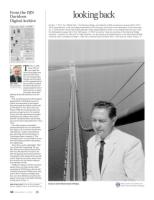
On Nov. 7, 2017, the “Mighty Mac,” the Mackinac Bridge, will celebrate its 60th anniversary. Lawrence Rubin (1912-
2010), pictured here, is the man largely responsible for the financing, construction and maintenance of the entire proj-
ect. A 1930 Detroit Central High School graduate, Rubin played defensive center on the football team the year it won
the Metropolitan League title in the 1929 season. In 1950, he became “executive secretary of the Mackinac Bridge
Authority,” a position he held until his 1983 retirement. He also served as secretary/treasurer of the International Bridge
Authority, which completed a bridge in 1962 that connected Sault Ste Marie, Mich., with Sault Ste. Marie, Ontario. •
T
he Nov. 6, 1942
issue of the JN
once again fea-
tured a front page story
about the War Chest.
For most of September,
October and November
in 1942, raising funds for
the war effort occupied
Mike Smith
Detroit Jewish News
the Detroit Jewish com-
Foundation Archivist
munity. Inside the Nov. 6
issue, however, a variety
of wartime stories that
affected the Jewish homefront were fea-
tured.
First, an advertisement for the Sampson
Supermarket on McNichols Avenue in
Detroit was interesting. It told readers
that patronizing the market would result
in “One Stop” to “Save Tires, Time and
Money.” While the market that does not
promote savings has yet to be invented,
the key bit in this advertisement, besides
making sure the audience knew that it
featured “nutritional food” and free park-
ing, was the store’s admonishment to “Save
Tires.”
One of the primary commodities
rationed during the war was automobile
tires. Many a car was driven around town
with bald tires. Another advertisement
also noted that the Detroit Institute of
Technology offered a number of “War
Training Courses” on such subjects as war-
time purchasing procedures and produc-
tion engineering.
Then, there was the subheadline: “Bob
Linx is Safe After Torpedoing.” Mr. and
Mrs. Edmund Linx had just learned that
their son, Bob, had been rescued at sea
after the Japanese had sunk his destroyer
in September 1942, along with the aircraft
carrier Wasp. This must have been a long
few weeks for the Linx family waiting to
hear that Bob was OK.
Finally, the Telenews Theater was show-
ing the Diary of a Polish Airman. Often
overlooked in WWII history, after the fall
of Poland, thousands of Polish Army, Navy
and Air Force veterans, including many
Jews, served in Allied forces. Indeed, they
played crucial roles in the Battle of Britain,
in Italy and on D-Day. •
Want to learn more? Go to the DJN Foundation
archives, available for free at www.djnfoundation.org.
62
November 2 • 2017
jn
Courtesy of Jewish Historical Society of Michigan.
Historic photos are curated by the
Jewish Historical Society of Michigan.