

jews d
in
the
Water
Justice
BARBARA LEWIS CONTRIBUTING WRITER
DJJ panels looks
at the effects of
water shutoffs on
local health.
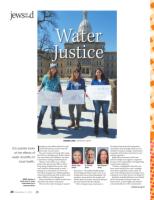
ABOVE: Members of
Detroit Jews for Justice
at World Water Day in
Lansing last March.
20
November 2 • 2017
I
magine you’ve fallen behind on your
water bill and the city has shut off
the water to your home.
You can’t wash your hands after using
the toilet or changing your baby’s diaper.
You can’t bathe your children. You have
a hard time cooking nourishing food.
Think it won’t affect you, a subur-
banite who always pays bills on time?
Keep going. Imagine that person who
can’t wash her hands going to work —
perhaps in a restaurant or a store you
visit often. Imagine the children going to
school and interacting with teachers and
other children at the playground.
Water shutoffs are a public health issue
that affect the entire community.
That was the main message at a panel
Monica Lewis-
Patrick
Dr. Paul Von
Oeyen
Rep. Stephanie
Chang
discussion, “The Public Health Impact
of Our Regional Water Crisis,” Oct. 23 at
Temple Kol Ami in West Bloomfield. The
program, sponsored by the temple and
Detroit Jews for Justice, attracted 100 peo-
ple from Detroit and the suburbs.
“We’re trying to raise awareness in
the Metro Detroit Jewish community
and build a base through which we can
mobilize for policy change,” said Eleanor
Gamalski, Detroit Jews for Justice’s com-
munity organizer.
Rabbi Brent Gutmann of Kol Ami
said the temple was eager to cosponsor
because of its long tradition of supporting
social action programs.
“I think a congregation that does not
have social action at its core is nothing
more than a glorified country club,” he
said. “If our Judaism does not inspire us to
transform our world, why are we doing it?”
Panelists included Monica Lewis-Patrick
of We the People of Detroit; Paul von
Oeyen, M.D., a retired high-risk obstetri-
cian and facilitator of the social justice
continued on page 22
jn