

jews d
in
the
RUTHAN BRODSKY CONTRIBUTING WRITER
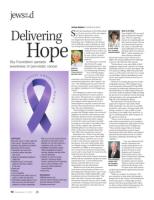
Delivering
Hope
Sky Foundation spreads
awareness of pancreatic cancer.
SYMPTOMS
Pancreatic cancer is often called the
“silent cancer” because the early
symptoms are painless and seldom
associated with the cancer.
• Depression and sad mood
• Jaundice (yellow skin/eyes,
dark urine)
• Rapid and unexplained significant
weight loss
• Significant pain in the upper
abdomen that often radiates
to the back
• Back pain
• Bloating
• Loss of appetite
• Discolored stools (either pale and
chalky or white and clay-like)
• Dermatitis (usually appears as dry,
flaky and itchy skin that doesn’t
respond to common treatments.
14
November 2 • 2017
jn
May be one of the earliest physical
symptoms of pancreatic cancer
although it is not often linked to a
malignancy until much later)
• Indigestion and stomach nausea
often accompanied by bouts of
vomiting. Heartburn and acid reflux
may also take place
• Diabetes is common among
patients in advanced stages.
Insulin is produced by the pancreas
and if a tumor develops in the
pancreas, insulin production
is less efficient
• Blood clots
RESOURCES
PANCAN (pancan.org)
American Cancer Society (cancer.org)
American Society of Clinical
Oncology (cancer.net)
S
heila Sky Kasselman of West Bloomfield
is a 10-year survivor of the most aggres-
sive form of pancreatic cancer.
“I was sick for almost a year before I
was diagnosed with pancreatic cancer,”
Kasselman says. “Symptoms of the disease
can be difficult to spot so finding out what
was wrong with me included several endo-
scopic procedures. Doctors
wanted to know if there was
a small tumor that couldn’t
be seen, which is typical
of most pancreatic cancer
patients.”
An endoscope is inserted
directly into the organ
allowing physicians to view
Sheila Sky
problems in the organ with-
Kasselman,
out making large incisions.
10-year survivor of
“Even with this diagno-
pancreatic cancer
sis, I was one of the lucky
ones because my cancer
remained in the pancreas and had not
metastasized [spread to other organs],” she
says. “This finding made me part of the 20
percent of pancreatic cancer patients who
are eligible candidates for the Whipple pro-
cedure.”
The Whipple procedure is the surgery
commonly performed to remove pancre-
atic cancer. The pancreas is an organ in the
abdomen that makes insulin, a hormone
that regulates blood sugar levels. It also
makes digestive enzymes secreted into the
intestine that help break down dietary pro-
teins, fats and carbohydrates.
“Interestingly, the number of patients
accepted for Whipple surgery has increased
slightly in the last few years because some
borderline patients receive chemotherapy
and radiation treatments before surgery
to shrink the tumor and make it possible
for surgery to take place,” says Robert Jury,
M.D, and the surgeon who started the
Multidisciplinary Liver/Pancreas Tumor
Clinic at Beaumont Hospital, Royal Oak.
“Our efforts have found some success.”
Kasselman says, “When I was first diag-
nosed with pancreatic cancer I knew little
about the disease, and there was no one
to talk to who had some experience with
the disease. Four and a half months after
my Whipple surgery, I established the Sky
Foundation [in 2008]; its main purposes
are to increase the awareness of pancreatic
cancer and to raise funds for research on the
early detection of the disease.”
November is Pancreatic Cancer Awareness
Month and the foundation will host its ninth
annual lunch Nov. 5 at the MGM Grand
Detroit. Call (248) 385-5143 or visit
skyfoundation.org for information.
“Sheila was one of the first resources I
used when my late husband, Robert, was
first diagnosed with pancreatic cancer,” says
Bluma Schechter of Bloomfield Hills, a Sky
Foundation advisory board member. “She
takes calls from everyone who requests
information about the disease and is totally
committed to funding research projects that
offer great potential for early detection of
pancreatic cancer.”
WHO IS AT RISK
Dana Zakalik, M.D., an oncol-
ogist at Beaumont Hospital,
says, “There is a growing
interest in researching hered-
itary factors in those who are
at increased risk for pancre-
atic cancer to describe why
Dr. Dana Zakalik,
some individuals are more at
M.D., oncologist,
risk than others. For instance,
Beaumont Hospital
BRCA 1 and 2 mutations are
often related to inherited
breast and ovarian cancer and occur at a
higher rate among Ashkenazi Jews although
at a lower rate than the other cancers.
“We also know we are more likely to find
symptoms of pancreatic cancer by screening
individuals with two or more first-degree rela-
tives [parents, sibling, child] with pancreatic
cancer as well as those who have two or more
second-degree relatives [grandparent, aunt/
uncle, niece/nephew] because they have an
increased risk.”
Advances in screening the pancreas involve
imaging the pancreas with techniques such
as an endoscopic ultrasound (EUS) and MRI
screening. An endoscopic ultrasound uses an
ultrasound device to make images of the pan-
creas from inside the abdomen. MRI screening
has proven to be an effective tool for detecting
early pancreatic cancer among people with
high risk of developing the disease.
The importance of early detection was
apparent in Supreme Court Justice Ruth
Bader Ginsburg’s case. She was successfully
treated for colon cancer 10 years earlier and,
during a routine CT scan in 2009, a tumor
was found in the middle of her pancreas. At
age 75, Ginsburg had her spleen and part of
her pancreas removed.
“There is a lot of activity in the scientific
and medical communities and a resurgence
of interest in finding new approaches to treat-
ment for pancreatic cancer,” Zakalik says.
“These include targeted forms of therapy
aimed at treating only cancerous tissue,
lowering the risk of side effects, and targeted
pharmaceutical treatment such as custom-
ized plans combining chemotherapy with
radiation. “
“I am very impressed with
Sheila’s enthusiasm and
energy raising funds to use
as seed grants for research
projects focused on early
diagnosis and treatment
of pancreatic cancer,” says
Bruce Gershenson of Franklin
and a member of the Sky
Bruce Gershenson,
Foundation advisory board.
member of the
“Both my mother and brother
Sky Foundation
Advisory Board
died from this disease, and
I’ve been active with various
medical and nonprofit organizations promot-
ing their efforts.
“Sheila is a wonder,” he continues. “She
goes anywhere to help others and speaks to
groups all over the country. The Foundation’s
seed money goes to cutting-edge research
projects that show promising results. Many
are able to obtain further financing from the
government and major institutions.” •