

arts&life
p ro f i l e
Born
To
Humor
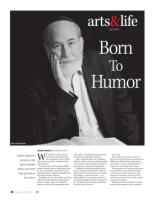
Rabbi Joseph Telushkin
SUZANNE CHESSLER CONTRIBUTING WRITER
Rabbi Telushkin
comes to talk
about Jewish
jokes and what
they say about
the Jews.
38
October 19 • 2017
W
as the shtetl a forerunner of
Catskills on Broadway? Why
are comedians so often Jewish?
Why are Jews so often comedians? Why
ask questions?
These are some of the questions Rabbi
Joseph Telushkin likes to think about. And,
he says, it’s possible to look far back into
texts important to understanding Judaism
and find examples of humor.
Telushkin can cite a few rabbis, one being
referenced in the Talmud, who employed
humor to make a point. The Talmudic
leader was known for beginning his talks
jn
with a joke or startling statement because
he wanted to get people’s attention.
“Jokes do get attention,” says Telushkin,
who has written a book and developed talks
on the essence of Jewish humor and the rea-
son it garners so much universal appeal.
Telushkin, an Orthodox rabbi by train-
ing and author of Jewish Humor: What the
Best Jewish Jokes Say About the Jews, brings
his findings — and lots of jokes — to a
Wednesday, Oct. 25, program sponsored
by the Jewish National Fund. His topic will
be “The Fifty Best Jewish Jokes and What
They Say About the Jews.”
Here’s one:
In the early years of Israel, when air
travel to the United States was much more
difficult, an official of the Israeli govern-
ment came to visit. A large delegation of
Jews went to greet him at the airport.
The man got out of the plane and some-
one asked him to describe the situation
in Israel in one word. “Good,” the man
answered. Somebody else in the crowd
asked for an answer in two words, and the
man said, “Not good.”
Telushkin explains that the irony repre-
sented in that vignette, which expresses