

white marble Armenian church corner-
stone, an Armenian silver chalice dated
1642 and the second Bible printed in
Armenian.
Melikian enjoys offbeat and unusual
items. In his rare Bible collection, he
has the one given by Donald Trump to
second wife Marla Maples. This collector
also enjoys sharing items with the public
and has brought 10 exhibits to various
museums.
Jewish works have been exhibited
at the Phoenix Art Museum, Arizona
Center for Medieval and Renaissance
Studies in Tempe and the Sylvia Plotkin
Judaica Museum at Congregation Beth
Israel in Scottsdale.
“I moved on to items from religions
besides my own because I like learn-
ing new things,” says Melikian, whose
parents, Greg and Emma Melikian, have
been supporters of the arts through
board memberships with the Arizona
Opera and Phoenix Art Museum.
“When viewers connect with artwork
— and there’s great artwork among the
religions — they get to understand the
spirit of various groups of people.
“I think one of the most impressive his-
toric groupings coming to Michigan from
my collection will be Jewish children’s
books from around the world. I’ve found
that there are more Jewish collectors
than Armenian collectors, and they are
very connected to their roots.”
Lucy Ardash, director of the
Manoogian Museum, also is impressed
with the books and looks forward to
arranging the entire exhibit as part of the
celebration of the 25th anniversary of the
museum.
“Both the Armenian people and Jewish
people went through tumultuous events,
and now people in Michigan can see
some of the antiquities that survived,”
Ardash says. “We hope visitors learning
about the Melikian holdings will read
about them, and we also hope they will
walk through the rest of the museum.”
The Manoogian Museum opened in
1992 and is spread out across 12,000
square feet. It was founded by industrial-
ist Alex Manoogian as both an artistic
endeavor and an attempt to reconstruct
the history of the Armenian people.
The facility showcases 1,500 items
divided among eight galleries and
includes illuminated manuscripts,
early printed books, rugs and carpets,
sacred vessels and vestments, textiles
and embroidery, ceramics, metalwork,
paintings, practical and personal objects,
ancient and medieval coins and objects
from Urartu, the ancient kingdom that
flourished in the Armenian
Highlands from the ninth to
the early sixth century B.C.E.
This will be the first time
that items from the James
and Ana Melikian Collection
will be featured in Metro
Detroit. The couple con-
nected with the museum
through Elizabeth Brazilian,
a family friend who is
active with the Manoogian
Museum and was interested in providing
something special for the anniversary
celebration.
“Although the exhibit coming to
Michigan focuses on Armenian and
Jewish heritage, I hope people represent-
ing all faiths will take a look and find
out more about the history of these two
cultures,” says Melikian, who visited the
Southfield museum in 2007 to gain addi-
tional insight into Armenian antiquities.
“I have met many people of different
cultures who share my interest in how
artifacts give insights into ethnicities,
and I have developed a special friendship
with Rabbi Darren Kleinberg, formerly of
Phoenix and now working in California.
Each of my days is enriched by gaining
more knowledge about a vast range of
history, centuries-old and recent.” •
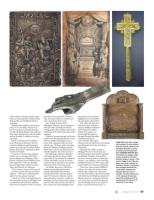
FACING PAGE: Dated 1923, probably
from Jerusalem, this silver-mounted
Torah case from the collection of the
late Shlomo Moussaieff is covered
in knotted carpet and topped with
bells. CLOCKWISE FROM TOP LEFT:
The Armenian Four Gospels, printed
in Venice on April 24, 1759, with a
solid silver binding. A Tanach, c. 1679
and all in Yiddish. A late-1700s gold
filigree cross, found in Ethiopia but
attributed to Armenia. A damascened
brass synagogue Chanukah lamp,
c. 20th-century. embossed with
menorahs, lions and a view of
Jerusalem. This silver Armenian arm,
c. 1837, represents the holy right
hand of God, possibly made for the
reconstruction of the Church of St.
Paul and St. Peter in Turkey.
jn
October 12 • 2017
47