

arts&life
IMAGE PROVIDED BY PVDE / BRIDGEMAN IMAGES, NEW YORK
exhibition
MUSEU DE ARTE DE SÃO PAULO
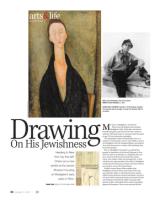
LEFT: Lunia Czechowska, 1919, oil on canvas.
ABOVE: Amedeo Modigliani, c. 1912.
FACING PAGE, CLOCKWISE: Caryatid, c. 1914, limestone. Caryatid,
1914, gouache and ink on paper. La Juive (The Jewess), 1908, oil
on canvas.
Drawing
On His Jewishness
Heading to New
York City this fall?
Check out a new
exhibit at the Jewish
Museum focusing
on Modigliani’s early
years in Paris.
DIANE COLE SPECIAL TO THE JEWISH NEWS
42
October 5 • 2017
jn
M
y name is Modigliani. I am Jewish.”
That is how the Italian artist Amedeo
Modigliani (1884-1920) often introduced
himself during the years he lived in Paris, where he
settled in 1906 and where he remained until his death,
at age 35, from tubercular meningitis.
This biographical detail will probably come as a
surprise to most people, who are more likely to associ-
ate Modigliani with the elongated figures and stylized
faces that characterize so many of his paintings than
his Jewish identity.
But as “Modigliani Unmasked,” an exhibit that
opened in September at the Jewish Museum in New
York City shows, his identity as a Sephardic Jew was
also central to both his personal and his artistic
vision. The exhibit, which runs through Feb. 4, 2018,
will showcase approximately 150 works by Modigliani,
mostly from his early years in Paris and many of them
never before seen in the United States.
Exhibit curator Mason Klein explains that
Modigliani arrived in Paris in the wake of the infa-
mous Dreyfus Affair, in which Jewish army captain
Alfred Dreyfus had been framed and falsely convicted
of treason before ultimately being exonerated. But the
anti-Semitism stoked by the affair remained wide-
spread, as did a nationalist-driven strain of prejudice
against all foreigners. These racist and anti-Jewish