

jews d
in
the
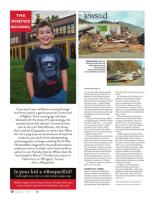
ABOVE AND RIGHT: Rabbi Asher
Federman amid the ruins on St.
Thomas. Many older homes
were not built with
hurricane-proof construction
that can withstand severe storms.
continued from page 16
10, a few days after Irma devastated
the island. From there they flew to
Milwaukee, where Henya’s parents
live. Two days later, they arrived in
Metro Detroit to stay with her brother
and sister-in-law — Rabbi Shmaya
and Devorah Leah Shmotkin. Asher
Federman remained on St. Thomas to
coordinate relief efforts for the Jewish
and general communities and to orga-
nize religious services for the High
Holidays.
Henya says her school-age children
are adjusting to the Lubavitch cheders
(schools) in Oak Park — a new experi-
ence because they relied on online
education on St. Thomas, which
has no Jewish schools. Their oldest
daughter, who is 12, already attended
a Lubavitch school here.
While the children miss their father,
“they understand why he is there,”
Henya says. There are 400 year-round
Jews on St. Thomas including retirees,
young people and business owners.
The community is really in need now
although people are looking out for
each other, she adds. Some have left
for good or for a few months. The
Federman family plans to wait until
the power and water systems are sta-
ble before returning to St. Thomas.
“St. Thomas is my home and I love
what we do,” she adds.
HELPING ON ST. THOMAS
Asher has organized relief efforts,
relying on donors and individuals
with private planes, both Jewish and
Christian, to transport essential items
such as generators, batteries, kosher
MREs (meals ready to eat), diapers
and other items. Their efforts have
18
October 5 • 2017
jn
been vital while the island’s ports were
closed.
He and others in the Chabad com-
munity are working with a Family
Resource Center and the govern-
ment to coordinate aid. Soon after
Hurricane Irma, Hurricane Maria
came through as a Category 2 storm,
Asher says, causing flooding and mud
slides. Many homes have tarpaulins in
place of roofs.
With no internet or much power,
residents don’t always know where
emergency distribution centers are
located. “So, we are delivering sup-
plies to them,” he says. “One hundred
families are targeted. Containers
arrived last Sunday from Houston and
Florida.”
Despite logistical and other obsta-
cles, Asher Federman held services for
the High Holidays. With a curfew in
place, he said that only those with cur-
few passes would be able to attend Kol
Nidre services at the Chabad House,
while others will pray at home, using
mahzors handed out before Yom
Kippur. In addition, a few individu-
als are staying at the Chabad House.
Asher blew the shofar in several loca-
tions on Rosh Hashanah and several
Jewish Marines assisting on the island
joined him in prayer.
He hopes to visit his family in
Detroit by Simchat Torah, but is
focused on relief efforts. “There are a
significant number of Jewish people
here,” Asher says. “They can’t leave
their homes and businesses and they
need us.” •
To aid Chabad efforts, visit chabad.org/
special/campaigns/hurricane/donate.htm.