
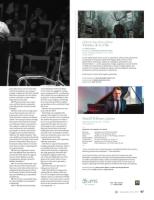

Photo by
Christophe Dessaigne
L’État de siège (State of Siege)
Théâtre de la Ville
by Albert Camus
Directed by Emmanuel Demarcy-Mota
Friday-Saturday, October 13-14 // 8 pm
Power Center
In this nightmarish future, a city is reduced to silence and submission
to authority. A character called The Plague takes control of the
government, imposing a regime of contagion, domination, and
disinformation — until a young man, Diego, organizes a revolt. Written
in 1948 in the aftermath of World War II, State of SiegeVIƫIGXWXLI
creation of a corrupt, totalitarian regime, weaving together paranoia,
endurance, and the necessity of resistance.
Performed in French with English supertitles.
Presenting Sponsor: James Garavaglia Theater Fund
Funded in part by: Wallace Endowment Fund
Media Partner: WDET 101.9 FM
past and present, and I’ve done that
with all my positions. I’m saying to
younger conductors [that they should]
find some repertoire very few others
perform and make a mark within a
repertoire of some kind.
JN: What have been your experi-
ences with the Jewish community,
especially because you have Jewish
heritage?
LS: One of the most moving experi-
ences I had was last year, when we
premiered a cello concerto by an
Arab-American composer at Shaarey
Zedek. I was trying to send a message
that music transcends the boundar-
ies of the place where you present it.
The audience could not have been
more enthusiastic and wonderful,
and maybe we opened a few doors.
I fought to have my friend Murray
Sidlin do The Defiant Requiem. That
was a definite outreach into the Jewish
community. If it can help create bonds
between communities that may not
have known they existed, we’ve done
more than our share of opening lines
of communication.
JN: Have you appeared in Israel
since the difficult time described in
your book? (After about five appear-
ances in Israel, Slatkin canceled
an appearance during a period of
Mideast hostilities.)
LS: I’ve not been asked back. I put
that at the end of the book because
that was a time when artists were can-
celing Israel [performances]. When
the Secretary of State [Colin Powell]
says you shouldn’t go, you probably
shouldn’t go.
JN: Do you have any specific ideas
for what you’d like to do outside of
conducting?
LS: I’ve already started teaching
at the Manhattan School of Music
in New York. I’m engaged in writing
some arrangements for a vocal group.
Then, there’s my own individual com-
posing. I’m 73 and would like to take
20 weeks a year without conducting.
Not consecutively. I’d like to explore
and go places in the world that I’d just
like to see.
JN: How do you look back on your
years with the DSO?
LS: I think I accomplished the
majority of the goals I set out. I feel
it’s time to turn this over to somebody
else and let that person see what to
do. I’m very proud of the growth we
made after the strike. We were one
of the leaders in the community to
help put Detroit back on the map.
During [the times of] web broadcasts,
concerts in the communities and the
tours, the orchestra’s name came to be
on most music lovers’ lips.
JN: What has been your experience
with the musicians?
LS: There is a special bond and fel-
lowship among the musicians. They’re
very flexible and easy to work with.
I always look forward to stepping on
the stage giving the downbeat and
hearing this magical sound come
out in this incredible hall, one of the
greats in the world. When we do a
big tour, I can’t wait to get back to
Orchestra Hall.
JN: What are your wife and son
doing as you move on?
LS: Cindy (McTee) is doing some
writing. My son, Daniel, who’s now
23, is in Los Angeles and is just begin-
ning his career as a television and film
composer. I can’t wait to go to a movie
theater and watch his name come up.
It may be the proudest moment I will
ever experience. •
Photo by Dario
Acosta-Deutsche Grammophon
Daniil Trifonov, piano
Wednesday, October 25 // 7:30 pm
Hill Auditorium
PROGRAM: AN HOMAGE TO CHOPIN
Mompou
Schumann
Grieg
Samuel Barber
Tchaikovsky
Rachmaninoff
'LSTMR
Variations on a Theme of Chopin
“Chopin” from Carnaval, Op. 9
Studie, Op. 73, No. 5 (“Hommage à Chopin”)
Nocturne, Op. 33
Un poco di Chopin, Op. 72, No. 15
Variations on a Theme of Chopin
4MERS7SREXE2SMRFƫEXQMRSV3T
“He is, no other word, a phenomenon. Like Rachmaninoff, he is both a
dazzling pianist and composer.” (The Guardian)
%X(ERMMP8VMJSRSZ[SRƪVWXTVM^IEXFSXLXLI8GLEMOSZWO]ERH
Rubinstein competitions. Now 26, this dazzling Russian pianist makes
his UMS recital debut after a wildly successful appearance with the
Montreal Symphony in 2016. He takes a deep dive into the music of
Chopin, exploring the Polish genius’s world and the music he inspired.
Supporting Sponsors: Diane and Gary Stahle and Robert and Darragh Weisman
Media Partners: WGTE 91.3 FM and WRCJ 90.9 FM
734.764.2538
——— U M S . O R G
jn
September 28 • 2017
47