

arts&life
music
Leonard Slatkin talks his new book,
his career and entering his fi nal year
as music director of the DSO.
SUZANNE CHESSLER
CONTRIBUTING WRITER
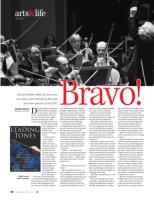
ABOVE: Leonard
Slatkin conducting
46
D
etroit Symphony Orchestra
(DSO) audiences regularly
see the serious side of con-
ductor Leonard Slatkin, but now
they also can gain some insight
into his sense of humor. Both
come across through anecdotes in
his new book, Leading
Tones: Reflections on
Music, Musicians,
and the Music
Industry (Amadeus
Press).
While the text
reveals insider
stories, it also
addresses issues
that have to do with
orchestral admin-
istration from his
point of view, some
in the headlines
and others behind
the scenes. There
also are lists with
explanations — his
favorite pieces to
conduct, things
musicians don’t
want audiences to
know and more.
The book is being released to
coincide with the beginning of var-
ious orchestra seasons as he tours
to New York, Washington and
St. Louis, and it will be available
September 28 • 2017
jn
B ravo!
as transition dominates Slatkin’s
thoughts. Beginning his 10th and
final year as music director of the
DSO, he looks ahead to indepen-
dent touring, teaching, writing his
third book and deciding whether
to continue living in Michigan.
Among his most satisfying
accomplishments have been com-
munity concerts, which increased
the attendance base by 3,500
people and gave the DSO a chance
to play more classical music than
most other United States orches-
tras, and the discounted price of
the Soundcard, which brought
more young people into the audi-
ence and was adapted by other
orchestras.
Slatkin — who holds seven
Grammys and has directed orches-
tras in St. Louis, Washington, D.C.,
and Lyon, France — talked about
the book and his future with the
Jewish News:
JN: What do you like about the
book?
LS: The people who know me
will recognize my voice, especially
the storytelling. There’s no ghost-
writer. Doing the reminiscences of
six people [including Isaac Stern
and Gilbert Kaplan] was fun.
Taking the time to go back and
research my dealings with 40 dif-
ferent orchestras [helped explain]
how I got wherever I landed.
JN: How does this book dif-
fer from your previous book
(Conducting Business: Unveiling the
Mystery Behind the Maestro)?
LS: I didn’t editorialize much
in the first book, but this time, I
do. I give suggestions for solving
some of the problems. Anytime I
go critically into matters, like labor
negotiations, I do it as I would like
to see it go. I put down what I’ve
seen and things I think need to be
worked on.
JN: Which sections were easier
to write and which harder to write?
LS: The one about six musicians
was easy because I have told many
of those stories to people. Getting
all the information from orchestras
— how many premieres did I do,
how much American music did I
play — was more time-consuming.
The humor chapters and the short
anecdotes were easy to do. The
think pieces, the ones delving into
issues confronting concert hall cul-
ture, were hard because things are
changing all the time.
JN: What compelled you to write
this book?
LS: A lot of people have heard
me speak on numerous occasions.
I just go and talk about whatever
I feel like talking about. I usually
tell a lot of stories and inject some
humor. People kept saying I should
put these down in a book. That
got me started. The first book sold
very well, and the publisher asked
if I would be interested in doing
another. It seemed the right time.
The next book might be geared
toward musicians themselves,
probably based on videos I do for
the website (leonardslatkin.com).
JN: How long did it take you to
write it, and did you have a writing
routine?
LS: It probably took a year and a
half. The routine developed out of
what my own schedule happened
to be. I probably did about half of
the book at my computer here at
the house, and the other half was
at hotel rooms or on the airplane.
JN: Did you ever keep a journal
or did you trust your memory?
LS: Mostly trusting the memory.
Since I’ve been writing pieces on
the web, I think starting in 2008,
that’s been a form of a diary. I can
go back and look at those. When
the chapters I wrote had potential
hot points, I corroborated informa-
tion from two sources.
JN: Did your repertoire priority
modify while you were in Detroit?
LS: No. Ever since I started, one
of the goals has been proselytiz-
ing for American composers both