

looking back
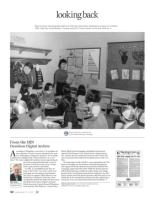
Back to school! Second-grade students at Hillel Day School listen attentively to a lesson on numbers,
1960. Hillel Day School Records, Courtesy Leonard N. Simons Jewish Community Archives. •
Historic photos are curated by the
Jewish Historical Society of Michigan.
From the DJN
Davidson Digital Archive
A
ccording to Wikipedia, a war chest is “a metaphor for
any collection of tools or money intended to be used
in a challenging or dangerous situation.” For example,
a politician’s campaign fund is often referred to as a “war
chest.” The name originated hundreds of years ago during an
era when a person literally kept a chest in
his home to hold the tools of war: swords,
knives, guns, powder and bullets.
In 1942, as exemplified by the Sept. 25
issue of the JN, the “war chest” cited on its
front page was the primary international
War Chest to support Allied efforts to win
World War II. Members of the War Chest
included the British War Relief Society, Greek
War Relief Association, Maple Leaf Fund,
Mike Smith
Detroit Jewish News
Polish-American Council, Queen Wilhelmina
Foundation Archivist
Fund, Russian War Relief Inc., United China
62
September 21 • 2017
jn
Relief, Allied Jewish Campaign (including United Jewish
Appeal), War Prisoners’ Aid, United Service Organizations
Inc., and the Detroit Community Fund. In other words, this
was an operation that reflected the global nature of the con-
flict.
The front page, in and of itself, is a very interesting read. The
basis for this page was the decision of local Jewish agencies
that supported the idea that the annual Detroit Allied Jewish
Campaign support the War Chest. While the Jewish agencies
still funded important, traditional welfare funds, now, a large
portion of the contributions from Detroit would go to the War
Chest. Further proof that Jewish Detroiters did their part to win
World War II. In consideration of Nazi’s atrocities against Jews
in Europe, it was not a hard sell for the local community. •
Want to learn more? Go to the DJN Foundation archives,
available for free at www.djnfoundation.org.