

rosh hashanah
B UY t S ELL
L EASE t M ANAGE
continued from page 28
serving
Oakland County and the
Entire Metro Area
www.MetroSold.com
Let our 150 years of combined experience and
knowledge guarantee the best possible outcome.
including Ann Arbor
TIMES OF ISRAEL
Get RESULTS
Residential & Commercial
Got Questions?
Jay Greenspan, Broker
Cari Cohen 248-574-1905 Direct
Sid Roth 248-202-3297 Direct
248-488-SOLD
Jgreenspan@metrosold.com
Regina Bronstein: Huntington Woods Specialist 248-298-9615 Direct
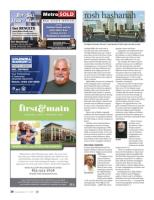
Yom Kippur has become “bike day” in Israel because all traffic ceases and roads are open.
MICHIGAN METROPOLITAN, REALTORS®
A DIVISION OF MICHIGAN PROPERTY MANAGERS
2162010
MEL DRYMAN
Raised in Detroit, Experienced in Arizona
Your Professional
& Dedicated
ARIZONA REALTOR
Mobile: (480) 239-8686
mel.dryman@azmoves.com
Each Office Independently Owned and Operated
2117430
ASSISTED LIVING I MEMORY CARE
OPENING FALL 2017 IN OAKLAND COUNTY!
Welcome to the lifestyle you seek, the care and
security you need and the dignity you deserve. Our
communities include The Village Square, 3 on-site
restaurants with Chef-prepared meals, a Concierge
approach to care and more. This is where life happens!
NOW ACCEPTING RESERVATIONS!
855-543-2636
WWW.FIRSTANDMAIN.US
3051 E WALTON BOULEVARD, AUBURN HILLS, MI 48326
100 W SQUARE LAKE ROAD, BLOOMFIELD TOWNSHIP, MI 48302
2500 MARTIN PARKWAY, COMMERCE TOWNSHIP, MI 48390
30
September 21 • 2017
jn
Ashleigh Miller, live and work in
Nairobi where they will celebrate
the High Holidays this year; Andrew
previously served in the Peace Corps
in Kenya. They are part of a small
Jewish community and know Ashley
Myers, head of Nairobi’s Jewish com-
munity. Myers describes the Hebrew
Congregation as a “microcosm of the
Diaspora” with both Ashkenazi and
Sephardic Jews. Eighty percent are
from Israel while many recent arriv-
als are from the U.S. Smaller numbers
are from Great Britain and a range of
other countries.
High holiday services are conducted
in the synagogue and a communal
Rosh Hashanah dinner and break-
the-fast meal are held in an adjacent
building. Myers says that the Rosh
Hashanah meal includes “a mixture
of Israeli and traditional food starting
with Israeli salads, tahini, hummus,
[then] chicken soup with matzah
balls and roast chicken.” Matzah and
matzah meal are difficult to import,
he says, so the community relies on
Jewish travelers to bring them to
Nairobi.
Myers, who is British, originally
worked in the hotel business in Kenya
but now serves as operations director
for Wells Fargo, a security company in
Kenya.
Founders of the Nairobi Hebrew
Congregation came from Europe
and South Africa beginning in 1899;
some emigrated to Kenya during the
1930s to escape the Nazis. A few were
farmers but most opened or worked
in retail or other businesses. Many
descendants of the early settlers con-
tinue as active synagogue members.
NEW ISRAELI TRADITION
In Israel, Rosh Hashanah and Yom
Kippur traditions represent the popu-
lation’s diverse religious and national
affiliations.
According to Arye
(Larry) Schwartz,
a former Detroiter
who has lived in
Jerusalem for more
than 40 years, most
Israelis go to shul for
the High Holidays,
Arye Schwartz
especially on Yom
Kippur, and have
family meals togeth-
er. He says that four foods are popular
among groups of all religious and
national origins — gefilte fish, pome-
granates, dates and honey.
“Sephardim and Ashkenazim have
very different ways and prayers for
the holidays, as well as different foods.
Within each sector there are also
many, many differences,” he says.
“For example, the Moroccan Jews
and their customs are very different
from the Yemenite Jews and their
customs. The Ethiopians have totally
different foods; however, their spe-
cial prayers almost no longer exist
as they have been absorbed into the
Sephardic prayers. A with a small
number of Ethiopians are part of the
Chassidic community.”
Schwartz says that secular Israelis
have developed some traditions of
their own. On Yom Kippur, many
children now enjoy a special bike ride.
“Children fill the streets and ride up
and down because there simply are
no cars on the road, even in secular
neighborhoods,” he explains. He points
out that riding a bicycle on Yom
Kippur is not approved from a reli-
gious viewpoint. However, he says that
in secular and mixed neighborhoods
(with non-religious and Orthodox
residents), many children of all back-
grounds look forward to taking over
the streets with bikes, skateboards and
rollerblades.
Closer to home,
Jay Katz, execu-
tive director of the
Windsor Jewish
Community Center,
says the Windsor
congregations are
Ashkenazi but
that the commu-
Jay Katz
nity includes some
Sephardim as well.
Customs are similar
to those in the U.S.
“There is a tradition of opening our
homes for the holiday to visitors and
having kugel, brisket and gefilte fish.
The food often depends on where the
landsman comes from,” he explains.
Katz adds that Windsor synagogues
welcome all to their services, espe-
cially students, without selling tickets
as some congregations in Toronto and
the Detroit area do.
Including honey in High Holiday
meals, whether used for dipping
apples, in honey cake or in baklava,
symbolizes the universal Jewish hope
for a sweet new year — a concept that
transcends geographic and denomina-
tional boundaries. •