

MYJEWISHLEARNING.ORG
rosh hashanah
S weet
&
Sacred
SHARI S. COHEN AND GENIA GAZMAN CONTRIBUTING WRITERS
High Holiday
traditions vary
with different
communities.
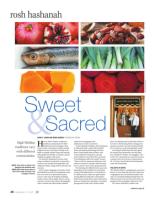
ABOVE: These foods are typical of the
Sephardic Rosh Hashanah seder.
ABOVE RIGHT: Rabbi Sasson Natan of
Keter Torah sounds the shofar in the
synagogue sanctuary.
H
ere in Metro Detroit, Ashkenazi
traditions predominate for Rosh
Hashanah and Yom Kippur. That
means many community members attend
religious services and enjoy a family meal
likely to include chicken soup with matzah
balls, gefilte fish, brisket or chicken, special
challah and apples with honey.
Yet Detroit’s Sephardic Jews have their
unique traditions and Jewish communities
overseas may include both Sephardic and
Ashkenazi dishes, along with local foods and
customs.
Keter Torah Synagogue is located in West
Bloomfield, but many of its Sephardic mem-
bers were born in or descend from Jews
across a wide area of the globe including
Turkey, Greece, Syria, Egypt, Morocco, Iraq
and Iran. It may be the only local synagogue
with a website that offers kosher baklava
made at the synagogue (visit
rabbisasson.wixsite.com/keter).
In the Sephardic tradition, Rosh Hashanah
is celebrated with a seder with symbolic
foods and individual blessings for them.
Keter Torah’s Rabbi Sasson Natan, who
is descended from Iraqi Jews, says the
seder tradition comes from the oral Torah.
“Everything goes after the mouth,” he says.
“That is why it is important all prayers and
wishes be stated in a positive form because
how we orate is how we live going forward.”
The blessings for different items may vary
depending on the tradition of a particular
country, but Rabbi Sasson, as he prefers to
be called, says the seders are quite similar
among different Sephardic communities.
Seder foods include dates, beets, black-eyed
beans or string beans, pumpkin or zucchini,
pomegranate seeds, and a small cooked
piece of a sheep’s head or fish head, which is
not eaten. The blessing before eating pome-
granate asks that “our mitzvot (good deeds)
be as numerous as the pomegranate seeds.”
According to Rabbi Sasson’s seder guide,
the sheep’s head symbolizes the idea that
Jews should be “leaders, not stragglers.” The
words “‘be a head and not a tail’ are based on
a pasuk (verse) in Devorim or Deuteronomy
28, 13.” Keter Torah held its Rosh Hashanah
seder this Wednesday.
HOLIDAYS IN KENYA
The Nairobi Hebrew Congregation, located in
Kenya, is more than 100 years old. Today, the
congregation has 150 member families who
meet in a beautiful building dating from the
1950s, located on the previous site of the con-
gregation’s first synagogue, opened in 1912.
Two native Detroiters, Andrew and
continued on page 30
28
September 21 • 2017
jn