

rosh hashanah
Symbolic Food
STACY GITTLEMAN CONTRIBUTING WRITER
The meaning
behind our
holiday nosh.
82
September 14 • 2017
B
eyond round challot, apples and
honey, there are many symbolic
foods to include in Rosh Hashanah
feasts designed to remind us of the themes
of the High Holiday season.
In fact, there is such a thing as a Rosh
Hashanah seder. Not as formal — or as
lengthy — as the Passover seder, the ritual
has its origins in the Talmud. It is essential-
ly a series of blessings for different foods
and a play on their Hebrew or Yiddish
translations. Each symbolizes the potential
of a new year.
“Any custom involving food is a good
one,” said Rabbi Bentzi Moussia Geisinsky
of Chabad of Bingham Farms. “The words
of the foods of the Rosh Hashanah seder
are closely related either in the Hebrew or
Yiddish language to other words that con-
vey either positive or negative omens and
have served us well from way back when as
well as right now.”
Positive omens revolve around increas-
ing blessings, fortunes, offspring and mitz-
vot. Negative omens stem from centuries
of persecution and ask in the new year that
the plans of enemies of the Jewish people
be cut off and eliminated.
A few foods or tastes to eliminate at a
jn
Rosh Hashanah meal include anything
sour or bitter. There is avoidance of using
vinegar and skipping the horseradish for
the gefilte fish.
Also, because the numerical value of the
Hebrew word for nuts, egot, is the same as
the Hebrew word for sin, chet, Geisinsky
said there is a custom of not including nuts
at a Rosh Hashanah meal.
Here are some examples of foods to
enhance your Rosh Hashanah festive
meals. Details of the seder, including
prayers, can be found at MyJewishLearning.
com or Chabad.org
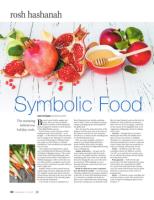
Apples and honey — the pair are the
most widely associated with the Jewish
new year. The apples for their roundness,
symbolizing the cycle of the year, and the
honey for hoping the new year will match
its sweetness. When dipping, we say a
blessing asking for a good and sweet new
year of renewal.
Head of a fish (or in some communi-
ties, the head of a lamb) — In some cases,
Geisinsky explained, just seeing a symbol is
a mitzvah. At some Rosh Hashanah feasts,
it is customary to display the head of a
fish or even a lamb and recite the blessing
that in the coming year we should be more
like the head (leaders) and less like the tail
( followers). This symbol has evolved for
those who see it as too graphic, which led
to the custom of serving gefilte fish, or for
vegetarians, displaying a head of cabbage
at the meal.
Carrots — Though there is no direct
blessing for this food, the Yiddish trans-
lation, meren, also means to multiply.
Therefore, it is customary to serve carrots
sliced horizontally into circles to represent
coins in hopes that that our prosperity, as
well as our family, will increase in size.
Leeks — In Hebrew, karti, the word
resembles yikartu, the Hebrew word for
“cut off ” as we ask that our enemies may
be cut off from their plans and not includ-
ed in the Book of Life.
Pomegranate — Full of seeds and
sweet juices, this fruit represents the many
mitzvot Jews are commanded to fulfill,
so a prayer here asks that in the coming
year, our merits will increase and our good
deeds be as numerous as the seeds in a
pomegranate.
Dates — In Hebrew, tamar resembles the
word for yitamu, to end. This sweet fruit is
eaten in hopes of ending the plans of our
enemies. •