

jews d
in
the
King
Solomon’s
Table
Tracing Jewish
recipes around
the world with
Joan Nathan.
PHOTOS BY VIVIAN HENOCH
VIVIAN HENOCH
SPECIAL TO THE JEWISH NEWS
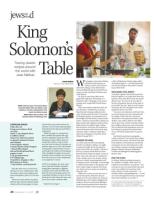
ABOVE: Chef Aaron Egan of the Eastern Market
Community Kitchen holds Joan Nathan’s latest
cookbook as she does a demonstration at the
Jewish Food Festival recently.
RIGHT: Nathan signs her books at the
Federation Women’s Philanthropy event.
AZERBAIJANI KUKUSA
3 tbls. olive oil
2 large sweet onions, sliced
very thin
About ½ cup chopped chives
3 scallions, diced
About 8 oz. fresh Swiss chard
or spinach, trimmed of stems
and chopped
3 cloves garlic, minced
1 bunch cilantro, finely chopped
½ bunch dill, snipped
Salt and freshly ground black
pepper to taste
1 tsp. ground turmeric
8 to 10 large eggs
A handful or arugula or other
bitter greens or herbs
½ cup walnuts, coarsely ground
Heat the olive oil in a 12-inch non-
stick pan set over medium heat. Add
the onions, chives, and scallions and
sauté until golden, about 15 to 20 min-
utes.
When the onion mixture is golden,
add the Swiss chard or spinach, garlic,
cilantro, dill, salt and pepper to taste,
24
September 14 • 2017
jn
and turmeric and cook for about 10
minutes over low heat, until any liquid
released from the spinach and herbs is
evaporated.
Whisk the eggs in a mixing bowl,
then carefully incorporate the eggs
into the vegetables and herbs in the
frying pan, using a rubber spoon to
smooth the surface. Cook covered,
over low heat, for about 10 minutes, or
until the eggs are set. The color should
be deep green, almost black. Uncover
and bring to the table in the frying pan
with a handful of arugula on top and
sprinkle with the walnuts. You can also
serve this cut up at room temperature
as an appetizer or snack.
NOTE: In Azerbaijan, the many varia-
tions of this dish includes vegetables
ranging from asparagus to eggplant
to squash. I have made this dish with
kale, bok choy and arugula and served
it sprinkled with feta as well as the nuts.
Just keep the ratios about the same, and
you’re sure to have a delicious dish.
Yield: 8-10 servings •
W
hat happens when Joan Nathan,
celebrated author known in
culinary circles as the “Queen
of Jewish Cooking,” meets Federation’s
Women’s Philanthropy for brunch? By no
means is it the usual kind of kuchen and
coffee klatch.
On Aug. 28, more than 200 women
gathered to talk food with Nathan at a
Federation 2017 Campaign event in part-
nership with Temple Beth El and Hazon
Detroit.
When Joan Nathan talks food, she’s all
over the place. Literally. She is a James
Beard Award-winning cookbook writer
with 11 books under her belt. A University
of Michigan alumna, encyclopedic in her
knowledge of Jewish history, ancient trade
routes, commerce and produce, dietary tra-
dition and Jewish migratory patterns from
biblical times through the ages, Nathan
has traveled to more than 30 countries to
amass the bounty of her latest book, King
Solomon’s Table: A Culinary Exploration
of Jewish Cooking from Around the World
(Alfred P. Knopf, 2017).
CONSIDER THE BAGEL
So, what makes Jewish food uniquely
Jewish? According to Nathan, we might
consider the bagel. In the introductory
pages of her book, she explains, “My favor-
ite way to picture Jewish food is as that
beloved Jewish staple, the bagel. A mass of
flour, water, salt and yeast is combined to
form a dough; and so, too, Jewish cuisine
has been created, using ingredients and
techniques local to its people. As the dough
is rolled and stretched, so the people, and
their cuisine, begin to spread. New ideas,
new foods and new recipes are picked up
along the way.”
Nathan has a story in every pot, uncov-
ered in thousands of kitchens she has
visited over the years. Before her Women’s
Philanthropy event, Nathan delighted her
audience at the second annual Michigan
Food Festival hosted by Hazon Detroit at
the Eastern Market. There she prepared
a dish of Babylonian (Iraqi) origin called
Azerbaijani kukusa — an herb-infused frit-
tata she described as “the perfect wander-
ing comfort food.”
WHAT MAKES FOOD JEWISH?
As Nathan explains, the Jewish foods that
hold us together as a people have three dis-
tinctions. First, they derive from the Jewish
dietary laws. “Even if you do not observe
the laws of kashrut, they are in the back of
your mind,” she says. “Just as are the music,
the prayer, the laws of Judaism, the whole
gestalt. It’s all is in our DNA.
“Second, is our obsession with food. Even
in ancient times, Jews were obsessed with
the quality of the food they consumed.
Ancient Jews were grain merchants, cattle
dealers, wine makers, bakers. Our tables
always have been central to family, celebra-
tion, religious observance and community.
We are obsessed with ingredients and care
how things are prepared, and that obses-
sion is carried from generation to genera-
tion.”
And third, Jewish food is adaptable —
eclectic and local. “Jews always have adapt-
ed food to the manner and where they have
lived. Judaism is international, and Jewish
restaurants are now international as well,”
says Nathan, citing two notable examples:
Balagan (Hebrew slang for hullabaloo)
in Paris and Mishiguene (Meshuggah) in
Buenos Aires.
PASS THE PLATES
In closing, Nathan’s parting message to
her audience is simple: “Pass down our
traditions in the kitchen,” she advises. “You
can’t go for carry-out sushi all the time and
expect our children to keep these tradi-
tions. I feel it’s our duty as parents — as
mothers, fathers and grandparents — to tell
our stories through the food we eat because
these food traditions are our life.” •
For more recipes from King Solomon’s Table, go
to joannathan.com. This story first appeared on
myjewishdetroit.org., where Vivian Henoch is editor.