
looking back
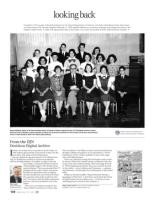
Founded in 1915 as part of the Detroit branch of the Zionist Organization of America, the Hayim Greenberg School, also known
as United Jewish Folk Schools (Vergand Folkshule), in 1950 adopted Hebrew as its primary language and changed its name to the
Hebrew-Yiddish Shule. In 1960, the approximate date of this photo, the school was located at Seven Mile Road and Schaefer. •
Movsas Goldoftas, director of the Hayim Greenberg School, is flanked by students ranging from ages 9-12. Photograph courtesy of Jewish
Historical Society of Michigan. Caption information is derived from the personal recollections of Rosa Chessler and Harmony and Dissonance,
Voices of Jewish identity in Detroit 1914-1967 by Sidney Bolko sky.
From the DJN
Davidson Digital Archive
I
found a lot of brief stories to ponder in the JN of Sept. 18,
1942. Indeed, along with the usual reports of Nazi evil, this
issue had a wide-range of interesting reports.
One story reflected a question posed in a JN editorial from
Aug. 25: Should Jews involved in crucial war production
observe the High Holidays? A headline on page 13 showed
that, locally, a conclusion had been reached:
“Detroit Rabbis Approve War Workers keep-
ing the Holydays.” They recommended that, “If
possible, Jewish workers whose consciences
lead them to spend these days in religious
devotion should seek some method by which
they can later make up the production time
lost.” This tells me that the rabbis understood
just how critical war production was to the
nation.
Mike Smith
Detroit Jewish News
There was a new feature on page six, the
Foundation Archivist
“Story of Ruth” in the form of a comic strip.
130
September 14 • 2017
jn
This was billed as “The Bible in Comics: Ancient Jewish Heroes
Brought to Modern Youngsters.” It was described as a “Novel
Experiment” by M. C. Gaines, publisher of nine comic maga-
zines with biblical themes.
There was a brief item noting that Yom Kippur music would
be aired on WWJ. This would be during a primetime radio slot,
no less, from noon-12:30 on Sunday. And, on the page devoted
to “What’s happening in Detroit,” there was an article devoted
to three faiths — Jews, Catholics and Protestants — condemn-
ing intolerance. I would argue this condemnation is still needed
today.
Finally, my favorite headline: “King of Denmark Attends a
Synagogue to Defy Nazis.” I don’t know much about the history
of King Christian, but one thing is sure — in the face of over-
whelming power, he showed some real guts. •
Want to learn more? Go to the DJN Foundation archives,
available for free at www.djnfoundation.org.
Historic photos are curated by the
Jewish Historical Society of Michigan.
Scanned image of the page. Keyboard directions: use + to zoom in, - to zoom out, arrow keys to pan inside the viewer.
September 14, 2017 - Image 130
- Resource type:
- Text
- Publication:
- The Detroit Jewish News, 2017-09-14
Disclaimer: Computer generated plain text may have errors. Read more about this.