
jews d
in
the
travel
continued from page 109
each person to receive
every month six pounds of
rice, two liters of oil, and 20
ounces of grains … When
meat is available to libreta
holders or now, to those who
have dollars, it is pork. Why
was Fidel sympathetic to the
Jewish dietary law? Was that
because he wanted to dem-
onstrate good will to the few
Jews that remained? Or was
it because of his acknowl-
edged Jewish ancestry?
THE 21ST-CENTURY STORY
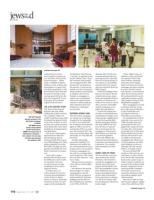
TOP LEFT: Beautiful
spacious sanctuary of the
Beth Shalom synagogue
in Vedado.
TOP RIGHT: Havana
Sunday school students
practice Israeli dances.
ABOVE: The second name of
Beth Shalom is Patronato —
from “patrons,” the rich Jews
of Havana who sponsored
this building in 1952.
The Soviet Union had col-
lapsed in the early 1990s,
sending the Cuban economy
into a tailspin. Fidel’s “tri-
umph” transitioned into what
he labeled the Special Period
in the Time of Peace. In real-
ity, that was a deep economic
crisis defined by a near-total
breakdown of transportation
and agriculture.
One of our Cuban guides
shared that her baby boy
died during the Special
Period, possibly from starva-
tion: Milk disappeared. Other
guides explained to us that
the traffic was light because
gasoline and diesel fuel were
hard to find and very expen-
sive.
Since 1959, Cubans
learned what the Jews knew
for 2,000 years: what it takes
to stay afloat. Life went
on and everyone in Cuba,
including the Jews, had to
adapt to survive.
In 1992, Castro cre-
ated a miracle: To turn the
economy from dependency
on the Soviets to depen-
dency on tourism, especially
American tourism, he used
magic words amending the
Constitution. Cuba became
a “secular” as opposed to the
former “atheist” state. Then,
the “enemies of the people”
who immigrated after 1959
became the “community in
the exterior.” A new law per-
mitted even the Communist
Party members to participate
in religious observances.
Going to a synagogue or
church was not punished
with severe repercussions
anymore. Cuban people got
their Christmas back and
Cuban Jews could again
become Jews.
ENTERING JEWISH CUBA
The first Cuban synagogue
we visited was in Santiago.
Founded by the Sephardim
in 1924, it was closed after
the revolution and reopened
again in 1996 to service its
community of 90 or so mem-
bers. But in March 2017, the
doors were locked again: The
last family, we were told, left
for Israel.
An older lady kindly
opened the building. The
sanctuary was locked, but
the communal hall was nice-
ly kept, and to see the photos
of former congregants on
the wall was a strange bitter-
sweet experience. The Cuban
Jews are alive and well — just
not in Cuba.
Havana, however, present-
ed us with an entirely differ-
ent story.
Our entrance into Jewish
Havana began in a rather
unusual place: a Jewish
hotel! The last occupant of
that beautiful Art Nouveau
building was the office of
the Food Industry, and then
in the 1970s, it fell into
disrepair. But with the gov-
ernment placing stakes on
growing tourism, especially
that of U.S. Jewish groups, it
was reborn as a beautifully
restored hotel now named
after the matriarch from the
Bible: Raquel.
Inside the building resem-
bles an art museum: Jewish
symbols interwoven seam-
lessly and tastefully with the
exquisite Art Nouveau ele-
ments. Every room is named
after a heroine of the Bible
and the restaurant serves
gefilte fish and blintzes.
To meet the Cuban Jews
of today, we left Old Havana
and headed to Vedado, a for-
mally upscale neighborhood
to visit the beautiful Beth
Shalom synagogue. Built in
the early 1950s by the rich
Jews of Cuba or “patrons”
(the second name for the
synagogue is “Patronato”),
Beth Shalom was restored
to its formal grandeur
in the early 1990s by the
American Joint Distribution
Committee and Miami Jewish
Federation. The complex
takes up almost an entire
block.
CUBA’S JEWS OF TODAY
We met with the vice presi-
dent of Patronato, David
Prinstein, who showed us
around the synagogue and
shared some of the syna-
gogue’s and his family’s his-
tory. His grandfather arrived
from Poland; his parents
became founding members
of the Cuban Communist
Party, passionate revolution-
ers. David was former mili-
tary, keeping quiet about his
Jewish origin.
When religion was con-
sidered a crime, said David,
the majority of Jews, like
other Cubans, separated
themselves from religion.
Many were born into mixed
marriages and often married
non-Jews. David’s second
wife, Marlen, is not Jewish by
birth. But even then, Jewish
life was kept afloat by surviv-
ing family memories and by
older people coming to their
dilapidated synagogues.
Three synagogues survived
in Havana after the revolu-
tion: Adas Israel (Orthodox),
Centro Sephardico and
the largest in Havana —
Patronato (Conservative).
An assimilated Jew, David
returned to his roots in the
1990s, through study and
participation in the syna-
gogue’s life, rising to become
its leader. His entire family
practically lives in Patronato.
All his children became bar
and bat mitzvah there and
are highly involved in the
synagogue’s life. Marlen con-
verted to Judaism and often
leads Shabbat services on
Saturday. She also teaches
Hebrew at Sunday school.
For most of about 800
members, Patronato is a sec-
ond home, a center of their
lives. The Jewish community
has become a place to go, to
study, to pray, to celebrate, to
eat and to get medicine. Beth
Shalom is supported by the
American Joint Committee
(“the Joint”) and receives
numerous donations, includ-
ing medical supplies, from
various groups.
There is no rabbi in Cuba,
but the Joint supports regular
visits of the rabbi from Chile.
continued on page 112
110
September 14 • 2017
jn
Scanned image of the page. Keyboard directions: use + to zoom in, - to zoom out, arrow keys to pan inside the viewer.
September 14, 2017 - Image 110
- Resource type:
- Text
- Publication:
- The Detroit Jewish News, 2017-09-14
Disclaimer: Computer generated plain text may have errors. Read more about this.