

looking back
From the DJN
Davidson
Digital Archive
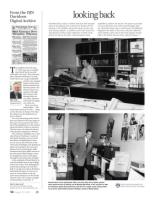
Mumford Music stores in Detroit and Oak Park featured
racks of the popular 45s (a seven-inch record with the
big hole in the middle), along with stacks of pop, clas-
sical and jazz albums. Customers came from across the
area because of the unique collections of these music
genres for sale at the store. Listening booths were
available to audition the record. The price to purchase
a 45 was 89 cents, plus three cents Michigan sales
tax. Mumford Music was so well known that Billboard
Magazine (the bible of the music industry) called the
store weekly to get a list of the most popular records
sold in the Detroit area for their national listings. •
T
he headlines from the Aug.
17, 1942, issue are a reminder
that World War II was still
undecided. One read: “Nazi Caucasus
Drive Threatens Palestine.” In 1942,
North Africa was a major battlefield
and the area changed
hands several times
between British and
German armies. The
threat of Nazis mov-
ing down through
the Caucasus and
through what are
now Syria, Lebanon
Mike Smith
and
Israel into Egypt
Detroit Jewish News
was a dire one.
Foundation Archivist
There was also a
sub-headline — like
most issues of the JN in 1942 — citing
a crisis for Jews in Europe. This time,
the subject was the desperation of
Jews in France.
Two very interesting stories about
Jews were found in the inner pages of
this issue. One was part of the series
the JN had published over the summer
about the history of Jews in America.
This last entry was about the history
of the Jewish community in Detroit.
Also related to Michigan was a story
about Bennie Friedman. A native of
Cleveland, Friedman was one of the
best-known football players of the
era. He was an All-American at the
University of Michigan who played just
about every position, but was most
famous for his passing game skills.
Friedman then spent eight seasons in
the National Football League, where
he changed the nature of the game
through his throwing of the football.
At the outbreak of World War II, he
was the football coach at the College
of the City of New York. Although the
article had nothing to do with foot-
ball, it was big news: Benny Friedman
had joined the Navy. He went on to
serve as a deck officer on the air-
craft carrier Shangri-La in the Pacific
Theatre of the war. Another example
of “Jewish Boys in the War.” •
Want to learn more?
Go to the DJN Foundation archives,
available for free at www.djnfoundation.org.
54
August 17 • 2017
jn
Mumford Music was the quintessential 1950s record shop. Betty and Lou Salesin (pictured
above) opened the store on Wyoming, next to Mumford High School, in 1951, and sold it in 1960,
but continued to operate their second store in Oak Park for a number of years. Photo provided
for use by the Jewish Historical Society of Michigan, courtesy of Michael Salesin.
Historic photos are curated by the
Jewish Historical Society of Michigan.