
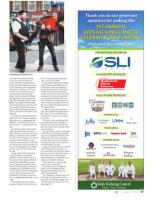

PHOTO BY FEDERICA VALABREGA, COURTESY OF MONGREL MEDIA
Lustig, Weinstein and Niborski on set
more open Lubavitch Chasidic
movement and a producer of
music and other videos deemed
proper for ultra-Orthodox viewers.
It was Finkelman who introduced
Weinstein to Lustig on a TV com-
mercial set more than two years
ago. Lustig already had made
comic YouTube videos in Yiddish
and aspired to earn more acting
jobs. The filmmaker said he imme-
diately was impressed by Lustig’s
performing prowess. Over the next
few months, Weinstein became so
taken with Lustig’s personal story
that he decided to fictionalize it for
Menashe.
“I wanted to make a film about a
father who has to make a decision
that seems very complicated and
difficult — and that would cause
himself pain — to help his son,” he
said.
In real life, Lustig’s father practi-
cally forced him into marriage in
2001 when he was 23, the actor said
during a telephone interview from
his home in New Square, N.Y. Yet the
union proved peaceful, he said —
until his spouse died after suffering
an ovarian clot seven years later. “It
was a very big tragedy, very sudden,
and our son was only 4 years old,”
he said.
Lustig and his British wife had
lived in London, but upon her
death he moved with his son back
to his native New Square. While in
real life his rabbi didn’t pressure
him to relinquish custody, Lustig,
who earns his living by working in
a kosher grocery, himself came to
realize that he could not adequately
care for the boy, who is now 14.
Eventually, he decided it was best
that a neighboring family take in the
child.
“But I fought with my feelings
because I wanted to have him next
to me,” said Lustig, who still man-
ages to see his son often.
Lustig said he had mixed feelings
when Weinstein asked him to star
in Menashe. On the one hand, he
already had appeared on YouTube
and had more acting aspirations,
despite some raised eyebrows in his
community. On the other hand, he
was concerned that the film’s con-
tent wouldn’t be entirely proper for
a Skver Chasid, a member of one of
the more insular Chasidic groups in
the United States.
Lustig was convinced to partici-
pate when Finkelman agreed to vet
the script. Even so, he did not ask
his rabbi for permission to perform
in the film.
“It’s better to do something with-
out asking rather than asking; he
tells you ‘no’ and you do it anyway,”
the actor said. “That would be much
more chutzpah.”
During the film’s shoot, Lustig said
he focused on performing, not reliv-
ing his own painful memories of his
wife’s death. “But when I watched
it on the big screen the first time, it
reminded me back to the bad anxi-
ety and feelings,” he said.
Lustig, who said he hasn’t received
much backlash from members of
his community over Menashe, added
that one reason he agreed to make
the movie was to encourage the
ultra-Orthodox to consider film as a
viable, and valuable, medium.
“This movie has a message for
every crowd,” Lustig said.
He recalled one non-religious
viewer who wondered why the
beleaguered Menashe character
didn’t commit suicide.
“So, I thought to myself, that’s one
of the big messages of the movie:
Don’t give up anytime,” Lustig said.
“There’s hope. One day, the sun will
shine again.” •
0002196880
jn
August 17 • 2017
37