

arts&life
PHOTO BY FEDERICA VALABREGA, COURTESY OF A24
film
A Chasid Grows
I n B rooklyn
In Menashe, an Orthodox grocery store
clerk fi ghts for custody of his son.
NAOMI PFEFFERMAN
JEWISH JOURNAL OF GREATER L.A.
Joshua Z. Weinstein
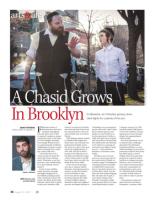
ABOVE: Menashe Lustig
and Ruben Niborski
36
August 17 • 2017
F
ilmmaker Joshua Z.
Weinstein has shot docu-
mentaries throughout
Asia and Africa, but in 2014
he aspired to explore a unique
community closer to his home
in Crown Heights, Brooklyn.
Even though Weinstein lives
in a predominantly Caribbean
neighborhood, insular commu-
nities of Chasidic Jews reside
just a short walk away.
“I loved that here was a
whole society just down the
street that I knew nothing
about,” Weinstein, a non-reli-
gious Jew, said. “Intellectually,
I was just endlessly curious
about it.”
So the 34-year-old film-
maker donned a yarmulke
and began hanging out in
the Yiddish-speaking enclave
with a notebook in hand. The
result is his debut feature film,
Menashe, which made a splash
at this year’s Sundance Film
jn
Festival, screened at the Berlin
International Film Festival and
has earned positive reviews. It
opens Friday, Aug. 18, in Metro
Detroit.
With dialogue almost entirely
in Yiddish (with English sub-
titles) and a cast of mostly non-
professional Chasidic actors,
the movie was shot in the most
observant neighborhoods of
New York. The plot is based
loosely on the experiences of
the film’s star, Menashe Lustig,
a Skver Chasid who in real life
had to give up his son after the
death of his wife in 2008.
In the movie, the protago-
nist, also a widower named
Menashe, is being pressured to
remarry or allow his brother-
in-law and family to raise
his 10-year-old son (played
by Ruben Niborski, the child
of Israeli Yiddish scholars).
Menashe’s rabbi and neighbors
perceive the likable bachelor as
a bumbling, even incompetent
parent who works a blue-collar
job at a kosher grocery and
hardly can care for Rieven in
his tiny apartment. Further, a
child must grow up in a family
with two parents, the kind-but-
firm rabbi insists. But Menashe
won’t settle for a marriage of
convenience; he fights to keep
his son — with sometimes
disastrous, sometimes comic
results.
The film is one of several
movies in recent years shot in
the mama loshen (Yiddish, or
“mother tongue”) including Eve
Annenberg’s Romeo and Juliet
in Yiddish (2011) and Laszlo
Nemes’ Auschwitz drama Son
of Saul (2015), which won the
Oscar for best foreign language
film. Menashe, for its part, is
not a harsh critique of the
Chasidic community, unlike
some previous films set in that
world (think Sidney Lumet’s
A Stranger Among Us in 1992
and Boaz Yakin’s 1998 drama,
A Price Above Rubies). The pro-
tagonist never loses his piety,
despite his ongoing dispute
with his rabbi.
But when Weinstein set out
to make his film, challenges
abounded. The filmmaker
had learned Hebrew as a boy
while attending a Conservative
Jewish day school in New Jersey
but didn’t speak a word of
Yiddish. Most of his potential
performers eschewed watch-
ing films on religious grounds,
had never seen a movie and
even risked excommunication
from their communities for
participating in such a proj-
ect. Weinstein didn’t include
a number of their names in
the credits in order to protect
them.
Circumstances improved
after Weinstein met Danny
Finkelman, a member of the