

arts&life
film
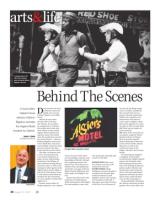
A vintage photo of the
1967 riots in Detroit,
used by director Kathryn
Bigelow in the film
Behind The Scenes
A local editor
helped movie
director Kathryn
Bigelow recreate
the Algiers Motel
incident for Detroit.
SHARI S. COHEN
CONTRIBUTING WRITER
David Zeman
34
August 17 • 2017
D
avid Zeman was born
in Detroit, where his
family once owned
Zeman’s Bakery on Twelfth
Street.
Almost 50 years after
the July 1967 civil disor-
der, Zeman, 58, accepted
an assignment to research
the people and events that
were central to the violent
Algiers Motel incident dur-
ing that unrest. His clients
were the production team for
the movie Detroit — director
Kathryn Bigelow and screen-
writer Mark Boal, who have
won multiple awards for their
previous movies The Hurt
Locker and Zero Dark Thirty.
This film, in theaters now,
is not a documentary but
is an intense depiction of
police racism and brutality
resulting in the killings of
three unarmed young African
American men, as well as the
beatings of other guests at the
Algiers Motel on the night of
July 25-26. John Hersey wrote
a well-known book about the
incident but the moviemak-
ers were unable to obtain film
rights for it.
Zeman, senior editor of
Bridge magazine, was a logical
jn
The Algiers Motel, recreated for Detroit
choice because of his exten-
sive journalistic expertise and
knowledge of Detroit. He had
led a reporting team at the
Detroit Free Press that won a
Pulitzer Prize and additional
awards for coverage of former
Mayor Kwame Kilpatrick and
other major investigative sto-
ries.
Zeman describes below the
experience of collecting in-
depth information that helped
the moviemakers create real-
istic portrayals of people and
events for the film.
JEWISH NEWS: How were
you chosen to work on the
research for Detroit?
DAVID ZEMAN: Hugh
Lindgren, executive producer,
contacted me because they
wanted someone to pull
together and oversee a group
of researchers in Detroit. I
had spent more than 20 years
at the Free Press. Because of
my day job [at Bridge maga-
zine], I couldn’t actually do
the research but I knew a
group of mostly retired jour-
nalists who would be very
interested in this kind of
work. I gave Lindgren a bud-
get and we agreed on it. That
was late in 2015 or early 2016.
JN: What was the nature of
your research?
DZ: Most of the research was
secondary, using the Walter
Reuther Library at Wayne
State University and the
Burton Historical Collection
at the Detroit Public Library
Museum, as well as the
archives of some of the
judges. We had 2 feet of docu-
ments.
We basically put together
a template of the people
involved: hotel [Algiers Motel]
guests, the Dramatics [the
musical group whose mem-
bers were brutalized there by
police], police officials and
retired cops, and contacted
them. The team asked basic
questions and then let them
talk so they could tell their
story as they remember it.
We found Melvin Dismukes,
the African American security
guard in the movie, Julie Ann