

jews d
in
the
continued from page 28
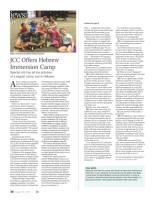
Campers in the local JCC’s Hebrew immersion program
JCC Offers Hebrew
Immersion Camp
Special unit has all the activities
of a regular camp, but in Hebrew.
A
dozen campers in a special
unit of the Jewish Community
Center of Metropolitan Detroit
Day Camp are part of a Hebrew
immersion program in which they
play, eat, enjoy sports and create art
surrounded by a supportive staff
of Hebrew language speakers who
gradually initiate them into Hebrew
proficiency.
Known as “Kayitz Kef”— mean-
ing “summer of fun” in Hebrew
— the program is coordinated by
Foundation for Jewish Camp (FJC),
supported continentally by the
Areivim Philanthropic Group and
is running now at nine day camps
across North America.
“Camp is such a fun, immersive
environment where Hebrew can be
a part of the experience,” says Batia
Kritzer of the local JCC. “We want all
of our campers to feel a true connec-
tion to, and comfort in, the language
and culture.”
Launched by the Areivim
Philanthropic Group as a design
experiment at Camp Ramah in Nyack,
N.Y., in 2013, Kayitz Kef has expanded
to additional camps across North
America as camp leaders, educators
and parents see its effectiveness.
Evaluation of the program shows
that campers grow in their Hebrew
language proficiency and gain a deep-
er connection to Israel and Israelis,
who serve as counselors and interact
with campers. Another evaluation by
Rosov Consulting shows that parents
also see their children can have fun
while learning Hebrew and they, too,
are positively influenced by its pres-
ence at camp. Some even become
inspired to learn Hebrew themselves.
“Kayitz Kef helps camps utilize
the proficiency approach to second
language acquisition,” says Shira
Ravin, Hebrew director for Kayitz Kef
30
August 10 • 2017
jn
at Foundation for Jewish Camp. “With
a team of native Hebrew speakers
trained in language acquisition meth-
ods, camps use Hebrew for commu-
nication between campers and staff,
among the campers and in camp-wide
settings. This provides opportunities
for campers to function in Hebrew
naturally in daily camp experienc-
es. A special connection forms when
Israeli counselors engage campers in
Hebrew, and activities campers will
remember for a lifetime happen in an
authentic, cultural and meaningful
Hebrew environment.”
Native Hebrew speakers serve as
project leaders for Kayitz Kef and
receive training by FJC in this pro-
ficiency approach and in different
methodologies to engage campers
in Hebrew acquisition. Counselors
also are native Hebrew speakers who
undergo a training process designed
to maximize the opportunity for
campers to interact and connect with
the counselors’ authentic “Israeliness”
— all while they implement Hebrew
proficiency throughout camp life.
The result is that Kayitz Kef pro-
motes acquiring rather than teaching
Hebrew, as campers are motivated to
communicate and function in Hebrew
in a short period of time and in a very
natural and fun way.
Kayitz Kef is supported by the
Areivim Philanthropic Group, a con-
sortium of major North American phi-
lanthropists committed to developing
and supporting transformational proj-
ects meant to significantly impact the
next generation of Jews through for-
mal and experiential Jewish, Hebrew
and Israel education. National funding
for Kayitz Kef is also provided by the
William Davidson Foundation, the
Steinhardt Foundation for Jewish Life,
the AVI CHAI Foundation and the
Marcus Foundation. •
thrive — to find their voice, to plan
and take the lead in some of the camp
activities and, by extension, to see
themselves as leaders and change-
makers in their home communities.
Additionally, we create opportu-
nities for campers to engage with
their peer groups and also cultivate
friendships and community with
campers of different ages. We can
create opportunities for campers to
be both a mentor and a mentee. I
see this play out in camp in beautiful
ways — fifth graders, for instance,
finding themselves in a leadership
role with third graders and seeking
out uniquely enriching mentorship
from older campers.
Q: How has your camping experi-
ence informed or shaped your own
leadership and Jewish identity?
AW: I often think back to those
first wilderness camping experiences
at Agree. I found that the closer I
got to the Earth, the more I could
recognize and realize my emotional,
mental and physical strength.
Now, I hope to create those same
empowering experiences for young
people, but also work to make con-
nections between camp and home.
I talk with both campers and coun-
selors about how to translate the
confidence that is often cultivated at
camp back into our lives during the
rest of the year.
Q: Who were your mentors?
AW: There have been many. I’m
indebted to my camp counselors,
who modeled inclusion and compas-
sion, and worked to make camp a
safe and empowering place for all
campers. But as a counselor in train-
ing, two mentors especially come
to mind: Tamar Gontovnik and the
late Jeff Grey both modeled different
kinds of beauty and strength, and
helped me realize that leadership
can look a variety of ways. I think
camp is really good at that. And
Camp Agree, in particular, put that
on the map for me.
As an educator at SCA and facili-
tator in youth programming, I took
pages out of the counselor guide
from Agree because those activi-
ties that help young Jewish folks
in Ontario feel powerful can help
create spaces for young people who
are in crisis or struggling to define
themselves.
I’ve used those same activities
again and again, and I’m excited to
return now and help, not just coun-
selors, but supervisors craft these
experiences for young people.
Q: What is your leadership style?
AW: A compassionate and curious
style of leadership has served me
over many years.
My method always has been to
be open and to share with people
my own vulnerabilities so they feel
there’s room for their strengths and
leadership on the team. I don’t have
all the answers to questions that
come up, but when you give people
the room and the voice to find
answers together, I find that people
are more willing to be honest and
share with one another.
Q: What is in your “backpack” —
what new programming do you hope
to bring to Camp Tavor?
AW: I see an opportunity to build
wilderness experiences at Camp
Tavor and am excited to work with
the youth leadership and summer
staff in developing it in a way that
feels safe and sustainable, and plugs
into all the incredible public spaces
that we have on the west side of
Michigan. And, I would really love to
include trail-building as the steward-
ship piece of the program. I believe
it is critical that recreation be inte-
grated with activities through which
campers can take responsibility for
our wild and beautiful public lands.
Q: Last question: What makes a
good trail?
AW: The big idea is water. Water is
enormously powerful and can erode
and do a lot of damage to trails. So
building trails is all about getting the
trail out of the water or getting the
water off of the trail. You can move
it, elevate it, dig drainage for it; but
whatever you do, you want to be
thoughtful in building it and concen-
trate use to preserve as much of the
wild as possible.
Additionally, you need to keep
your users in mind when developing
trails and building trails to “points of
interest.” The big idea is to provide
the most sustainable route to the
places where people want to go and
the sites they’d like to see! •
This story first appeared on myjewishdetroit.
org, where Vivian Henoch is editor.
TRAIL MATES
Blazing her own trails this summer, Amit moved her stakes from Hamtramck to
Camp Tavor in June. Joining her for the summer was her beshert, Evan Major,
a social worker for Wayne Westland Community School District. It comes as
no surprise to friends and family that they planned a Camp Tavor wedding “on
grass, gravel and dirt,” where guests were advised to wear comfy shoes.