

arts&life
books
as the “Queen of Cooks,” who
used food to climb the social
ladder and was rumored
to have had an affair with
Edward VII before he ascend-
ed to the throne in the United
Kingdom.
There’s also Helen Gurley
Brown, the longtime
Cosmopolitan editor and the
author of Sex and the Single
Girl. Brown had a complex
relationship with food and
often turned to dieting, eating
celery sticks and sugar-free
Jell-O, and proclaiming that
“skinny to me is sacred.”
The impetus for What She
Ate came from a passage
Shapiro discovered in a biog-
raphy of Dorothy Wordsworth,
devoted sister to William
Wordsworth, the Romantic
poet. She kept house for
her brother in the quiet and
beautiful Lake District of
England. Their idyllic country
life changed when William
married and Dorothy wound
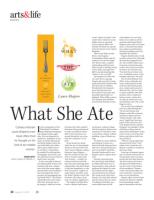
What She Ate
Culinary historian
Laura Shapiro’s new
book offers food
for thought on the
lives of six notable
women.
AVISHAY ARTSY
JEWISH JOURNAL OF GREATER L.A.
32
August 3 • 2017
I
n the closing days of the
Third Reich, Eva Braun
kept drinking Champagne
and eating German apple
cake. She was desperate to
maintain a semblance of nor-
malcy as bombs fell around
the Berlin bunker where she
and Adolf Hitler hid. When
Albert Speer, Hitler’s favor-
ite architect, visited them,
he recalled Eva offering him
Champagne and sweets, and
she expressed concern that he
hadn’t eaten recently.
It may seem glib to discuss
the dining habits of Nazi com-
manders and their compan-
ions while that same regime
intentionally starved millions.
But food played the role of
promise and propaganda dur-
ing World War II. “The Führer
repeatedly said, and I repeat
after him, if anyone has to
go hungry, it shall not be the
jn
Germans but other peoples,”
Hermann Göring announced
in 1942, and indeed, almost
half of what Germany con-
sumed during the war came
from the countries it occu-
pied.
In her brand-new book,
What She Ate: Six Remarkable
Women & the Food That Tells
Their Stories (Viking), culinary
historian Laura Shapiro —
who has written for the New
Yorker, Gourmet and Conde
Nast Traveler — profiles six
women in history and tells
their life stories through their
relationships with food. Braun
is the least empathetic, as she
lived “encased in a sphere of
make-believe morality” until
her death, Shapiro writes. But
for Braun, like others, food
took on a deeper significance.
The subjects include Rosa
Lewis, a British chef known
up living in a distant village
with her nephew. Shapiro was
surprised to read that a cook
served them a dinner of black
pudding, a type of blood sau-
sage.
“It’s kind of a mess of blood
and oatmeal. I mean, it’s a
beloved British thing and they
still eat it with great pleasure,
but it sure didn’t sound like
Dorothy Wordsworth to me,”
Shapiro said in a phone inter-
view.
Dorothy’s journals from
her time living with William
are filled with references to
the gooseberry tarts and gin-
gerbread she baked, the rum
she bottled and the apples
she picked from the orchard.
She would recall visits from
friends, the meals they shared
and the poetry that was read.
“Cooking, for Dorothy, was
inextricable from her life
with William: To serve him
food was to reinforce all the
emotions that bound them,”
Shapiro writes. But in her later
years, as Dorothy descended
into sickness and dementia,
the black pudding seemed to
symbolize her decline.
Shapiro had the idea to look
at other women’s lives through
the food they prepared and
ate. She avoided culinary pro-
fessionals, instead choosing
women who weren’t necessar-
ily known for what they ate.
“You don’t have to have writ-
ten a cookbook to have a rela-
tionship with food,” she said.
The novelist Barbara Pym
didn’t write cookbooks; she
wrote widely praised works
of fiction that featured spin-
sters, clergy and sessions of
afternoon tea. The tea “plays
so many symbolic roles that
another writer would have
had to create a whole slew
of walk-on characters to say
what Barbara says with a cup,”
Shapiro writes.
The novels Pym published
from the 1950s through the
’70s are full of food, and
Shapiro works like a forensic
scientist to figure out how
“boiled chicken with white
sauce” might have been pre-
pared. Pym’s characters ate
well, despite the low opinion
foreigners are thought to have
of British cooking, and she
enjoyed describing their meals
in her novels, even if her pub-
lishers and editors didn’t see
the need for it.
“What is wrong with being
obsessed with trivia?” Pym
asked in her notebook, and
Shapiro could have wondered
the same thing.
Food was of minimal impor-
tance to Eleanor Roosevelt, or
at least that’s what everyone
around the first lady believed.
“By all accounts, the food in
the Roosevelt White House
was the worst in the history
of the presidency,” Shapiro
writes, and most people who
were invited for a meal there
knew to eat beforehand.
Shapiro offers several expla-
nations for Eleanor’s disdain
for homemaking, includ-
ing her frustration with her