

eretz
our israeli home
Israeli Startups
SHARI S. COHEN CONTRIBUTING WRITER
Ben-Gurion
University
scientists seek
to advance
healthcare.
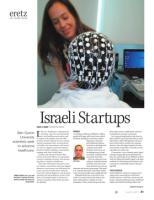
ABOVE: EIMindA uses a cap with
electrodes to measure the brain’s
electrical activity and assess any
abnormalities.
I
n the U.S., healthcare is big business
— patients want the most advanced
care, and healthcare providers seek
to improve the quality and cost-effec-
tiveness of their clinical services. Israeli
startup companies have a strong focus
on health care innovations, such as bet-
ter ways to diagnose and treat disease,
monitor health conditions, and analyze
imaging and other health data.
Faculty and alumni of Israel’s Ben-
Gurion University (BGU) are among the
country’s leading scientists with promis-
ing ideas to improve healthcare.
They have developed innovative ways
to evaluate concussions and neurological
diseases; screen more cost-effectively for
some cancers; provide better informa-
tion from echocardiograms; and develop
solutions for big healthcare needs. Their
ideas are being brought to fruition by
startup companies that think and oper-
ate globally.
EIMINDA
According to officials at EIMindA, 2 billion
people of all ages suffer from brain-related
disorders including concussions, autism,
depression, dementia
and Parkinson’s disease.
Scientists at this high-tech
company, led by BGU
Professor Amir Geva, are
developing ways to diag-
nose brain conditions more
accurately and earlier.
They are using new tech-
Amir Geva
nology to understand brain
networks and assess such
brain functions as memory,
attention and sensory processing. Their goal
is to “map the functions of the brain similar
to the way that Google maps neighborhoods.”
EIMindA’s BMA uses a cap with 64 elec-
trodes to measure electrical activity in the
brain while patients complete tests for
stimulation. These results, along with data
from other sources, enable brain activity to
be classified as normal or abnormal.
Geva says existing baseline tests (such as
EEGs and PET scans) don’t provide as much
information. With 1,000 patients who have
been tested with its systems, the company
claims to have the largest database for elec-
trical activity in the brain. Currently, 35 clini-
cal studies are under way.
Concussions, a very common sports injury
among young people and professional ath-
letes, are a particular focus. EIMindA worked
with the National Football League to develop
methods for determining when players with
concussions could safely return to the play-
ing field.
TODOS MEDICAL
Todos Medical is a biotech company devel-
oping cancer screening tests with better
results and lower costs than current tests for
breast, colorectal and lung cancer. CEO Rami
Zigdon and Chief Technology Officer Udi
continued on page 32
jn
July 20 • 2017
31