

jews d
in
the
continued from page 94
the Jewish and Chaldean Opportunity
Builders, a volunteer partnership that
was my first exposure to the Motor City
Blight Busters, the Redford Theatre and
Sweet Potato Sensations.
When I told my uncle about the article
and asked if he read the Jewish News, he
gave a reply that, better than anything
I’ve heard since, captures just what an
exceptional part of our exceptional com-
munity this is — “What kind of a**hole
doesn’t read the Jewish News?”
And just like I had to leave Detroit to
find my way to the Detroit Jewish News,
I had to leave Jewish Detroit to find my
way to Dexter and Elmhurst, where my
fellow imported-from-Detroit Motor
Citizens and I painted a gymnasium so
Detroit PAL could bring new basketball
programming to the “the old neighbor-
hood.”
Where he is now: Ben Falik is …
Imported from Detroit.
HERSCHEL FINK:
Journalist
Reflecting on a long
career (hopefully not
yet over) working for
news organizations, I
have fond memories of
my first paying journal-
ism job at the Jewish
News. Part of its attrac-
tion was talking history with Jewish News
founder and publisher Philip Slomovitz.
His stories were better than history class.
He actually knew Israel’s founders as well
as America’s leaders. He delighted in tell-
ing stories, and I was eager to hear them.
My job began about 1960, while a
student at Wayne State. It was a con-
siderable step up from my prior job,
delivering meat for Schechter Brothers
kosher butcher shop on Wyoming. But,
it still lacked excitement. Basically, I took
amateur press releases from community
organizations, turning them into artful
prose (well, let’s just say grammatical
prose). But, I soon asked if I could cover
community events and speeches, and
thus graduated to actual news stories
that earned bylines. Now that was excit-
ing. My mom had nachas, and I was off
and running.
I continued working at Wayne’s stu-
dent newspaper, the Daily Collegian,
becoming “editor-in-chief.” I’ve never had
a more impressive title. I then spent three
years as a copy editor and reporter at
the Flint Journal, followed by seven as a
reporter and, eventually, night city editor
at the Detroit News.
Along the way, I earned a law degree,
leaving journalism to practice law with
Detroit’s Honigman Miller Schwartz and
Cohn law firm, specializing in represent-
ing local and national media compa-
nies. I also represented the JN on First
Amendment matters while an attorney
with Honigman Miller.
After 35 years as a partner, I began
my “encore career” almost five years ago
as legal counsel for my longtime client,
96
July 18 • 2017
jn
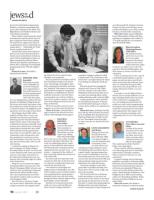
News Editor Alan
Hitsky, JN owner
Charles Buerger
and Editor Emeritus
Philip Slomovitz
the Detroit Free Press, and five sister
Michigan news properties.
But, my passion for journalism and the
First Amendment began at the Jewish
News. Interestingly, my daughter, Sheri
Fink, a physician by education and train-
ing, “inherited” that passion, far surpass-
ing her father’s meager-by-comparison
journalistic accomplishments. She left
medicine to become a New York Times
correspondent, now with two Pulitzer
Prizes to her credit, as well as a New York
Times best-selling non-fiction book, Five
Days at Memorial.
All this is traceable, at least in some
measure, to my time at the Jewish News.
Where he is now: Herschel Fink is
legal counsel for the Detroit Free Press
and five other Michigan-based papers.
JONATHAN
FRIENDLY:
News Editor
I came to the Jewish
News sometime in
the fall of 1996, when
Alan Hitsky was look-
ing for copy-editing
help. When Julie Edgar
left, I took over as news editor, working
directly for [JN Editor] Bob Sklar. The
work was challenging and fun, requir-
ing me to learn about the intricacies of
the Detroit Jewish community and the
organizations that served it. I was — and
remain — impressed by the vitality of
that community despite the pressures of
21st-century life.
But what made the experience truly
unusual was Bob. He was the first boss I
ever had who actually asked about and
cared about my Jewish soul.
I was raised in a thoroughly non-
religious home in Washington, D.C. But
both my father’s and my mother’s fathers
were assimilated Jews, and somehow I
identified much more with that ethnic
background than with the dogmas of the
Episcopalian school I attended.
Questions of neshamah [my Jewish
soul] never arose until my 60th year,
when I started working with Bob. I
remember writing a column in which
I styled myself “The Newish Jew at the
Jewish News” and talked about the values
I was finding in reading the Torah por-
tion.
When the Jewish News bought the
Atlanta Jewish Times in 1998, I filled
in for five months as the editor there.
[Publisher] Arthur Horwitz kept me on
as a part-time national editor, mostly
writing editorials, until I retired in 2000.
I remain grateful to Arthur and Bob
for tolerating my ignorance of all mat-
ters Jewish and for giving me a chance
to learn about a history too important to
forget.
Where he is now: Jonathan Friendly
lives with his wife in Florida. He doesn’t
get to Southfield often but played some
duplicate bridge there in May. He said
he was “thoroughly trounced by play-
ers who, I am sure, are loyal Jewish News
readers.”
LONNY GOLDSMITH:
Staff Writer
During my time at the
Detroit Jewish News
(June 1997-July 1999),
I was lucky enough to
cover the Detroit Jewish
Community Center
at a time when it was
embarking on huge changes in terms
of fundraising and renovations. But, as
a sports fanatic, I got great opportuni-
ties to travel to Pittsburgh to cover the
Detroit Maccabi team, cover (and coach
soccer) when Detroit hosted in 1998, and
help spearhead a large special-section
dedicated to the [Maccabi] Games.
I was lucky enough to work with a
great editor in Jonathan Friendly, who
always knew when to push, nudge, sug-
gest and encourage.
The Detroit Jewish News will always
hold a special place in my heart, not
just because it was a fixture in my home
growing up, but also because it was the
first place I worked after graduating from
Michigan State University. Working in
Jewish communities in both Chicago and
now Minneapolis/St. Paul since leaving
Detroit, my time at the DJN gave me an
excellent foundation as not only a writer,
but also a steward of the community.
Where he is now: Lonny Goldsmith
lives in Minneapolis with his wife, Ilyse,
and their two daughters. He is editor of
TC Jewfolk and director of communica-
tions for Jewfolk Media.
Illana Greenberg
Marketing Director
(1995-2007)
My husband, Danny,
and I were at an event
for the new plan-
etarium at the Detroit
Science Center when
Arthur [Horwitz] called
to tell me our offices were on fire. We
arrived to find the building ablaze and
little chance to retrieve our files and
computers.
It was an amazing time to be a part of
a staff that banded together to get the
paper out and not miss a beat for the
weeks and months that followed. Soon
after, we celebrated the paper’s 60th
anniversary and, along with the com-
munity, felt proud of what we accom-
plished.
Currently, I work for Hillel of Metro
Detroit, the on-campus Hillel for six col-
leges including Wayne State University.
As the endowment campaign direc-
tor, I am helping raise funds that will
enable new and creative programming
for students who are the future leaders
of Detroit. I am proud to be associated
with organizations that support and
impact our Jewish community, and I
congratulate the JN on its 75th anniver-
sary!
ALAN HITSKY:
News Editor/Associate
Editor
I worked at the Jewish
News from 1974 to 2011
as news editor, associ-
ate editor and several
stints as interim editor.
I joined the JN the year
after the Yom Kippur
War, replacing city editor Charlotte
Dubin, who made aliyah.
When I started, editorial employees
were still using paste pots to send hand-
edited stories to linotype machines.
When I retired, the internet was well-
entrenched.
I enjoyed working with the following
publishers and editors: JN founder Philip
Slomovitz, whose impaired vision did not
keep him from being a Jewish visionary
in Detroit and nationally; Philip’s son,
Carmi, who ran the business side of the
paper; Charles Buerger of Baltimore, who
bought the JN in 1984; award-winning
editor Gary Rosenblatt; publisher Arthur
Horwitz; and editors Philip Jacobs and
Robert Sklar.
Where he is now: Alan Hitsky is
retired. He volunteers at Yad Ezra kosher
continued on page 98