

jews d
in
the
continued from page 74
JEFFREY SACHS
Though he’s got a nonstop global travel
schedule, Jeffrey Sachs says he always
tries to get back to Detroit when he can.
Currently an economics professor at
Columbia University and special adviser
to U.N. Secretary General Antonio
Guterres, he is often on the road pro-
moting solutions to poverty, health,
education and the environment.
His work resonates with the values he
learned from the Detroit Jewish com-
munity, says Sachs, who grew up in Oak
Park during the 1960s and attended Oak
Park public schools.
“That was an era of enormous tumult,
but also of enormous national ambi-
tion and of the great goals of social jus-
tice,” he says. “This is how I will always
remember growing up in the Detroit
area, as part of a wonderful community
that was also deeply engaged in the
great issues of the day. I couldn’t have
asked for more.”
He went on to Harvard, where he
spent 30 years, first as a student and
then as a professor. In 2002, he moved to
New York for his current work.
The Detroit Jewish community had as
its central message the key principle of
being a mentsh, he recalls. There were
also Shabbats, High Holidays, bagels and
lox, all part of his upbringing, he says.
“As I work every day across all religions
with Muslim, Buddhist, Christian, Hindu
and other leaders — and across all 193
nations of the U.N. — I find the message
of social justice and tikkun olam is uni-
versal and vital for a good life.”
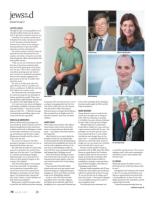
Jeffrey Sachs
Adam Grant
in January 2013, and moved over to serve
as deputy managing editor for the New
York Times earlier this year. She started
with the WSJ in 1995 in the paper’s
Detroit bureau, covering General Motors.
She currently lives in Maplewood, N.J.,
with her husband, Alan Paul, and three
children.
REBECCA BLUMENSTEIN
Rebecca Blumenstein’s grandparents
met in Detroit. And her parents are from
Detroit, though their travels took them
to Maine, then back to Michigan to settle
in Essexville, outside Bay City. Growing
up around farms and factories taught
Blumenstein humility and the value of
hard work, she says.
She went on to attend U-M, where
learning to navigate on one’s own was an
important life lesson, she says.
She adds that she believes many of the
answers to questions the country faces
right now lie in the state. “I see Michigan
as a vibrant, fascinating and hugely
important place on so many levels, in
terms of what’s going to happen in the
country,” she explains.
And she’s always glad to meet people
from home, she adds. “As journalists,
we’re trained not to generalize, but I
can tell you when I meet anyone from
Michigan in sometimes very far-flung
places, my husband jokes I jump into
their arms. There’s a certain kinship one
feels almost immediately.”
Blumenstein worked as deputy editor
in chief for the Wall Street Journal starting
ADAM GRANT
When Adam Grant and his wife, Allison
Sweet Grant, come to town, they draw
straws to choose between favorite deli
spots — his, Pickles & Rye Deli and hers,
the Stage Deli.
Metro Detroit is very much about the
people for Grant. He was deeply influ-
enced by family friend the late Jeff Zaslow
and Grant’s late grandfather, Jay Grant. He
met his wife in graduate school at U-M,
and when he left Michigan in 2007, he
took with him “some amazing friendships
and (apparently) a Michigan accent.”
Some of his favorite Michigan memo-
ries are from the time he spent at Camp
Tamarack and Camp Taguna, where he
says he discovered a love of waterskiing
and tennis.
Grant attended West Bloomfield
schools and went on to get master’s and
doctorate degrees in organizational psy-
chology at U-M. He and Allison currently
reside in the Philadelphia suburbs.
Grant is a New York Times bestsell-
ing author of Give and Take, Originals
and Option B (co-authored with Sheryl
Sandberg). He is a top-rated Wharton pro-
Rebecca Blumenstein
Noam Neusner
fessor with consulting clients including
Facebook and Google, the NBA and the
Gates Foundation.
NOAM NEUSNER
Noam Neusner came to work for the
Jewish News straight out of college in
1991-1992. He remembers meeting
U-M Hillel’s Executive Director Michael
Brooks while covering local colleges.
“Michael helped me understand
Jewish life in totally new ways, and was
a great mentor and friend,” he says. “He
probably was the first person I knew
who understood how to work within
institutions and change them at the
same time — a valuable skill that has
affected my whole life. Most of all, he
taught me you can make your contribu-
tion to Jewish life in many ways.”
Neusner worked another decade in
journalism and, in 2002, joined the White
House as a speechwriter for President
George W. Bush, who he also served as
liaison to the Jewish community. After
leaving the White House in 2005, he
established a strategic communications
firm, 30 Point Strategies, with offices in
Washington and Atlanta.
Neusner fondly remembers his JN boss,
Phil Jacobs, and is still in touch with jour-
nalists he worked with at the JN, he says.
“It was my first job out of college, and I
had a lot to learn — these great colleagues
were so helpful in the process, and I’ve
never forgotten them.”
The Detroit Jewish community wel-
Eli and Edye Broad
comed him warmly, he says. “It’s an amaz-
ing place, and I wish more communities
around the country stuck together like
Detroit’s does.”
ELI BROAD
Eli Broad’s parents decided to move to
Detroit from New York City’s Bronx when
he was 7.
Immigrants from Lithuania who moved
to the U.S. to escape anti-Semitism and
find new opportunities, his parents had
a strong influence on him, he says. His
father opened two five-and-dimes, and his
mother kept the books.
“I learned entrepreneurship from my
continued on page 78
76
July 18 • 2017
jn