

jews d
in
the
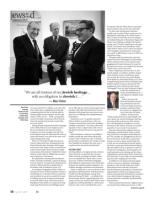
COURTESY GERALD FORD ARCHIVES
continued from page 56
“We are all trustees of our Jewish heritage …
with an obligation to cherish it … ’’
— Max Fisher
Max Fisher,
President
Gerald Ford and
U.S. Secretary
of State Henry
Kissinger at the
White House
two-year yield of $11.2 million, a record at the
time. Fisher gave a significant personal gift,
symbolizing just how far he had traveled in
awakening his Jewish impulses. His first gift,
made in 1932, was $5 — while a young sales-
man for his father at Keystone Oil in Detroit,
where his parents had moved to from Ohio
two years earlier.
During that pivotal period for the Campaign
in the 1950s, Fisher, by now hugely success-
ful in oil refining via his Aurora Gasoline
Company, was wise enough to not pit local
needs against Israel. He called Jewish needs at
home and abroad “two sides of the same coin”
representing Jewish unity.
When U.S. President Dwight Eisenhower
tried to cajole Israel into retreating from the
Sinai Peninsula after claiming it from Egypt
in the Suez crisis, Fisher took a cue from local
Labor Zionist leader Morris Schaver’s public
renunciation of Eisenhower’s belief the United
Nations would calm the Middle East, accord-
ing to Harmony & Dissonance.
In a diplomatic meeting with Eisenhower,
Fisher “privately and firmly” expressed dismay
toward “what he considered the abandonment
of Israel.” Still, Israeli forces pulled back in
December 1956, in deference to the U.N.
According to biographer Golden, Fisher, as
UJA general chair, visited Eisenhower’s farm in
Gettysburg, Pa., in October 1965 to ask the for-
mer president to accept an award for his part
in helping rescue the remnants of European
Jewry from Hitler’s fury. Fisher had entered
Republican Party politics in a big way by help-
ing George Romney become Michigan gover-
nor in 1964. By now, Fisher had merged Aurora
Gasoline with Ohio Oil (which later became
Marathon Oil), giving him more time to navi-
gate the ever-shifting whirl of philanthropy
and politics.
Eisenhower, now 75, quickly warmed to
Fisher. Golden recounted how, as the con-
versation wound down, the former president
wistfully commented, “‘You know, Max, look-
ing back at Suez, I regret what I did. I never
should have pressured Israel to evacuate the
Sinai.’”
What Eisenhower said next, according to
Golden, would stay with Fisher till the day
he died. “Max,” Eisenhower said, “if I’d had a
Jewish adviser working for me, I doubt I would
have handled the situation the same way. I
would not have forced the Israelis back.”
HOLDING SWAY
Exerting influence in high-powered corridors
of government was precisely the role that
Fisher wanted, according to Golden. Fisher
was ever-mindful that “Israel exists so Jews
may exist.” Golden’s 1992 Fisher biography,
Quiet Diplomat, captured the tenor of this gen-
tle giant who defused political landmines via
wisdom, foresight, persistence and charisma.
Fisher would go on to serve as adviser to the
Republican administrations of Richard Nixon,
Gerald Ford, Ronald Reagan, George H.W.
Bush and George W. Bush — on behalf of the
Jewish people and the organized Jewish com-
munity, not just on Israel’s behalf. Fisher never
imagined an ambassadorship or cabinet post;
he knew such a role would limit the access
he enjoyed with the White House and Israeli
prime ministers the last 40 years of his life.
For their part, Israeli prime ministers
would come to value Fisher’s ready access to
Republican leadership in the White House —
how “in time of need, Max moves its hinges,”
as Yitzhak Rabin put it. Menachem Begin said
Fisher’s heavy lifting on behalf of the Jewish
people was of “historic significance and mag-
nitude.” Even Democratic presidents could
value Fisher’s “deep concern about our future”
and “exemplary commitment to improving
our world,” as Bill Clinton wrote in a 1994 con-
gratulatory letter.
Though unofficial ambassador and inter-
mediary between Washington and Jerusalem,
Fisher understood he was an American Jew
grappling with Israeli interests. He wasn’t in
the game for money or accolades, but because
“Israel exists so Jews may exist.”
Fisher’s diplomacy between the U.S. and
Israeli capitals, according to Golden, helped
clear the briars so Jews could leave repres-
sion in both the Soviet Union and Ethiopia.
Such diplomacy also helped bring a U.S. arms
resupply during Israel’s 1973 Yom Kippur War,
helped confront America's threatened 1975
reappraisal of ties with Israel unless Israel
“disengaged’’ from the Sinai Peninsula, helped
tackle the resettlement of
Soviet and Ethiopean Jews —
and helped accomplish much
more.
Robert Aronson, the
Detroit Federation’s former
top professional and now
senior development adviser,
proudly considered Fisher
Robert Aronson
his mentor. In a digital inter-
view in the Max M. Fisher
Archives, Aronson said:
“Many people don’t know, and probably will
never know, the extent of influence that Max
has had and the importance of his interac-
tion with Republican presidents at crucial
moments in the history of Israel. It was indis-
pensable. It was crucial. It was historic.”
Beyond reinforcing the pipeline between
Washington and Jerusalem, Fisher worked
long and hard to strengthen Israel-diaspora
ties. For example, he spotlighted how Jews in
the Soviet Union, North Africa and Eastern
Europe, not just in Israel, needed help. Key
to this was reconstituting the Jewish Agency
for Israel, a quasi-governmental Israel agency.
JAFI provided services or grants for rural set-
tlement, for immigration and absorption, for
youth education and training, and for urban
rehabilitation and housing. Fisher chaired the
JAFI board for 12 years and was elected found-
ing chair after stepping down in 1983.
In addition to serving local Jewish organi-
zations in a host of capacities, including as
president of the Detroit Federation, Fisher
held national roles with the Council for
Jewish Federations (president), United Jewish
Appeal (chair), United Israel Appeal (chair),
American Jewish Joint Distribution Committee
(vice chair), Hebrew Immigrant Aid Society.
American Jewish Committee and B’nai B’rith
International.
Fisher earned Detroit Jewry’s highest honor,
the Fred M. Butzel Memorial Award, in 1964.
continued on page 60
58
July 18 • 2017
jn