

jews d
in
the
Celebrating
75 Years!
continued from page 46
that touched on the European trag-
edy in one fashion or another. After
reviewing burial figures in Warsaw,
Slomovitz concluded in May that the
worst was happening. At times, he
seemed prescient about the events,
stating, “There is nothing in all human
records to compare to such tragedy,”
yet offering no plan of action except
to increase donations. At other times,
he seemed unable to comprehend
the gravity of the events, as when in
June he called the Warsaw Ghetto the
worst ghetto of all times but observed
that the Jews in the Ghetto were
building gardens and not allowing
the Nazis to stop them from elevating
themselves.
In August, he wrote that while the
lot of Polish Jewry was intolerable,
Polish Jews would carry on “in order
that they may live to celebrate the vic-
tory of decency over brutality.” Even
after he reported on the death of more
than a million Jews, he wrote that the
Jewish tragedy would be “mitigated in
the course of time” and that after the
war the European Jewish communi-
ties would be rebuilt.
Slomovitz aggressively used his edi-
torial power to raise funds to combat
anti-Semitism and to advocate his
Zionist agenda, but, during 1942, he
seemed more passive when it came to
action that could help save European
Jews. Certainly, the funds he helped
raise were critical; and his columns
publicizing the war effort supported
his belief that the fastest way to end
European tragedy was to defeat the
Axis, but there was little written advo-
cating protest or urging a change in
United States policy or otherwise try-
ing to “stir the masses.”
His editorials tended to be more in
the form of lamentations or expres-
sions of hope, rather than calls to
action. Despite his close relationship
with Arthur Vandenberg and his will-
ingness to leverage that friendship
when it came to Zionism or anti-Sem-
itism, archival records do not suggest
the men corresponded in any mean-
ingful way about European Jewry.
Slomovitz’s reaction to events in
Europe mirror what many historians
have found about journalistic reac-
tion generally. Many historians have
considered the lack of protests and
the reasons for it. One view was that
Jewish organizations wanted to be
viewed as “serious sober” American
citizens to avoid disloyalty charges
by anti-Semites, and noisy rallies and
public protests would work against
that. Some blame divided national
leadership, and others, the singularity
of the event — the crime was just too
big to comprehend.
With our historical perspective, it
is hard to imagine Slomovitz, truly
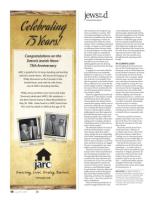
Congratulations on the
Detroit Jewish News’
75th Anniversary
JARC is grateful for its long-standing partnership
with the Jewish News. We honor the legacy of
Philip Slomovitz as the Founder of the
Jewish News, and with his wife Anna,
one of JARC’s founding families.
Philip, Anna and their sons Carmi and Gabe
Slomovitz dedicated JARC’s 9th residence —
the Beit Channa Home in West Bloomfield on
May 28, 1986. Gabe lived in a JARC home from
1972 until his death in 2009 at the age of 79.
rmi Slomovitz
Philip and Ca
(1986)
Carmi and G
abe Slomovi
tz
(1986)
Enriching Lives. Erasing Barriers.
www.jarc.org
2187590
48
July 18 • 2017
jn
a man dedicated to his profession
and his people, optimistically writing
about growing gardens in the Warsaw
Ghetto or relegating news of mass
murders to small back-page articles,
but in the period immediately after
America’s entry into the war, the truth
of the Holocaust would seem impos-
sible. By December 1942, however, the
New York Times and other publications
reported that rumors of the “final
solution” were true, and the tenor
of English-Jewish reporting would
change.
THE SLOMOVITZ LEGACY
The founding of the Detroit Jewish
News at this transitional time was a
fortuitous event for Philip Slomovitz,
Jewish Welfare Federation of Detroit,
and ultimately, the Detroit Jewish
community. The newspaper added
cohesion and a strong communal
voice and allowed communal lead-
ership a platform to keep the com-
munity moving forward by raising
more money for the Campaign than
anywhere else in the nation, help-
ing the War Chest also reach record
numbers, fighting anti-Semitism,
promoting Zionism as a solution for
European Jewry, and supporting the
war effort monetarily, patriotically
and with service to country.
The Jewish News was the commu-
nicative tool that reached, informed
and educated most Jews in Detroit
on behalf of those community lead-
ers.
Slomovitz repaid his investors
quickly and became sole owner of
the Jewish News. He would eventu-
ally buy the Chronicle in 1951 and
shut it down.
Slomovitz and the Jewish News
would experience a lifetime of
accolades and success. The Jewish
Information Bureau called him a
“leading voice in American Jewish
journalism and one bright light on
the American Jewish press scene.”
The Jewish News became a true
unifying force in the Detroit Jewish
community — no matter where a
Detroit Jew fell on the political, class,
education or religious spectrum, he
would turn to the Jewish News each
Friday. In the end, Slomovitz suc-
ceeded in what he set out to do in
1942 — mold Jewish public opinion,
strengthen the Jewish community
and advance the morale and courage
of American Jews. •
Alan M. Hurvitz is an adjunct professor at
University of Detroit-Mercy Law School and is
of counsel to the law firm of Honigman Miller
Schwartz and Cohn. He received his B.A.,
J.D. and M.A. in history all from Wayne State
University, where he continues to do research
in the area of the Detroit Jewish community
during World War II.