
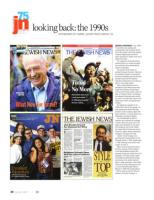

looking back: the 1990s
SPONSORED BY: KIMMEL SCRAP IRON & METAL CO.
AMERICA PROSPERED in the 1990s.
The economy was growing and
unemployment was shrinking. By the
end of the decade, Americans enjoyed
a federal budget surplus and dra-
matic reductions in violent crime and in
deaths from AIDS.
The collapse of the Soviet empire
lessened fears of a nuclear Armaged-
don and South Africa dismantled its
system of apartheid.
The election of Bill Clinton as
president brought America’s might and
the president’s powers of pursuasion
into focus, facilitating the Oslo Accords
between Israel and the Palestine
Liberation Organization and outlining a
path to a two-state solution.
Many Jewish Detroiters were in
attendance at the White House when
Israeli Prime Minister Yitzhak Rabin
and PLO Chair Yasser Arafat, under the
gaze of President Clinton, exchanged
an awkward handshake seen around
the world. Two years later, much of the
world would mourn the assassination
of Rabin.
The digital age exploded in the
1990s. By the end of the decade, we
were enjoying the World Wide Web,
browsers, search engines, digital cell-
phone networks, 3-D video games and
affordable and powerful laptops.
The JN celebrated its 50th an-
niversary and continued its coverage
of Israel, while more and more of its
pages were dedicated to local news
and milestones. By the late 1990s,
the Jewish News had become one of
America’s largest weekly publications,
averaging 148 pages per week.
Charles “Chuck” Buerger, who
purchased the Jewish News from the
Slomovitz family in 1984, passed away
in 1996 following unsuccessful heart
surgery. He was 57.
News of note included the birth of
Yad Ezra, the sale of Sinai Hospital
to the Detroit Medical Center, with
proceeds forming the Jewish Fund, the
dedication of the Max Fisher Federa-
tion Building in Bloomfield Township,
controversy at the Jewish Home for
Aged, a major expansion of the Jewish
Community Center infrastructure and
a record-setting Michigan Miracle
Mission in 1993 that brought almost
1,300 to Israel to mark the 45th an-
niversary of Israel’s founding. •
34
July 18 • 2017
jn