
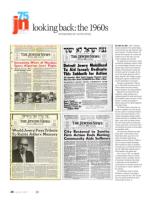

looking back: the 1960s
SPONSORED BY: EATON STEEL
ON JAN. 20, 1961, John F. Kennedy
became president of the United States,
and Americans had high hopes for what
was to become “The New Frontier.” By
the end of the decade, the country had
landed a man on the moon, but was
mired in political and civil strife.
The beginning of the decade in Israel
included the clandestine capture of Nazi
war criminal Adolph Eichmann, his sen-
sational trial in Israel and his death by
hanging. Philip Slomovitz covered the
trial from Israel for his readers. By the
end of the decade, Israel was still eu-
phoric about its 1967 military success,
enabling the capture of biblical lands
and the reunification of Jerusalem.
Kennedy’s assassination in Novem-
ber of 1963 jolted the world, with the
Detroit Jewish community offering
special homage to the young president.
Meanwhile, the Vietnam War was
expanding, college students were
mobilizing against the draft and the war,
and President Lyndon Johnson’s “Great
Society,” including the passage of
federal voting and civil rights legislation,
was taking shape.
The Detroit Jewish community con-
tinued its migration out of the city and
into the suburbs of southeast Oakland
County. Communal institutions, most
notably Congregation Shaarey Zedek,
opened their doors in Southfield. Devel-
opers, many from the Jewish commu-
nity, were instrumental in erecting the
houses, apartments, commercial, office
and industrial structures to accomodate
the population shifts.
The community suffered two major
blows within a short period of time.
Rabbi Morris Adler was shot on the
bimah of Shaarey Zedek during
Shabbat services in March of 1966, in
front of several hundred worshipers.
After shooting the rabbi, his assailant
turned the gun on himself and took his
own life. Rabbi Adler passed away at
Sinai Hospital a few weeks later.
And, in July of 1967, an outbreak
of unprecedented violence in Detroit
resulted in dozens of deaths, the loss
of hundreds of buildings, the looting
or destruction of vast quantities of
merchandise from business owners and
the acceleration of Jewish migration to
the suburbs.
The celebratory mood of Jewish
Detroiters, a carryover from Israel’s
success during the June 1967 Six Day
War, was quickly tempered by these
events closer to home. •
28
July 18 • 2017
jn