
jews d
COURTESY RABBI LEO M. FRANKLIN ARCHIVES, TEMPLE BETH EL
in
the
continued from page 112
However, with two local Jewish weeklies on the scene
and tighter economic conditions brought on by men
off to war, Merzon had to cease publication.
JEWISH COMMUNITY
The weeklong program of activities marking the
dedication of the new Yeshiva Beth Yehudah building
on Dexter and Cortland to house the afternoon and
Sunday Hebrew school culminated on Washington’s
birthday while the first issue of the Jewish News
was being planned. At the time, the United Hebrew
Schools was headquartered in the Rose Sittig Cohen
Besides worrying about relatives and friends
serving in the armed forces, Detroit’s Jews were
hearing about the heart-wrenching reports
from Europe.
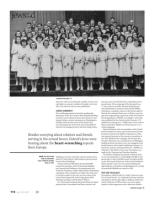
ABOVE: The first Temple
Beth El confirmation
class of Rabbi B. Benedict
Glazer in 1942.
Building on Lawton and Tyler, and the system had a
staff of 42 with almost 1,500 students spread around
several school buildings.
Samuel and Leah Bookstein donated $25,000
toward the purchase of the Professional Building
on Linwood and Elmhurst to be transformed into
Yeshivath Chachmey Lublin. Rabbi Moshe Rothenberg,
a graduate of the institution in Lublin who had come
to America earlier in the year, served as dean of the
school that temporarily used Congregation Beth
Yehudah on Pingree and Woodrow Wilson.
In a 1942 board meeting, the Jewish Home for Aged
reported that 146 residents had been cared for the
previous year. One left the home voluntarily and 19
passed away. The average age of the deceased was
77 years and two months. Herman Pedarsky, gen-
eral administrative assistant of the Jewish Welfare
Federation, compiled a report on the Jewish Aged of
Detroit. He estimated there were 4,140 Jews over the
age of 60, representing 4.6 percent of the total Detroit
Jewish population of 90,000. According to census fig-
ures published by the Detroit Jewish Chronicle, 1.75
million Jews among the 4.7 million Jews in the United
States stated that Yiddish was their primary or sec-
ondary language.
Henry Wineman, who was president of the United
Jewish Charities for three years and became the first
president of the Jewish Welfare Federation in 1926,
was named chairman of the executive committee of
the 1942 Allied Jewish Campaign. For the past four
decades, Wineman was considered one of Michigan’s
leading business executives as he was engaged in the
family business, the People’s Outfitting Company. To
honor the memory of Joseph Westman, a $5,000 con-
tribution to the Hebrew Free Loan Association was
made by the Westman and Davidson families.
The Hebrew Hospital Association of Detroit went
on record stating that it would pledge $42,000 to any
group able to raise $150,000 toward a hospital within
a year. The board of directors of the Jewish Children’s
Home agreed to turn over its vacant building and
adjoining lots on Petoskey and Burlingame for a hospi-
tal provided $200,000 was raised in 1942.
HATE AND HOLOCAUST
Newspapers called Gerald L.K. Smith “America’s num-
ber one anti-Semite.” An ordained Protestant minister
and leader in the Ku Klux Klan in Indiana, Smith relo-
cated to Detroit in 1939 as there were more oppor-
tunities to find supporters and to fund anti-Semitic
continued on page 116
114
July 18 • 2017
jn
Scanned image of the page. Keyboard directions: use + to zoom in, - to zoom out, arrow keys to pan inside the viewer.
July 18, 2017 - Image 115
- Resource type:
- Text
- Publication:
- The Detroit Jewish News, 2017-07-18
Disclaimer: Computer generated plain text may have errors. Read more about this.