
jews d
in
the
75th Anniversary
I
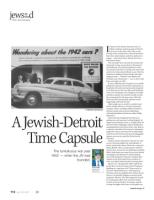
A 1942 Buick advertisement
A Jewish-Detroit
Time Capsule
The tumultuous war year
1942 — when the JN was
founded.
Irwin Cohn
Special to the
Jewish News
n March 1942, Detroit had more than 1.7
million residents and thousands of Detroit
men were on the other side of the ocean
serving in the Armed Forces. Detroit boasted it
had seven radio stations and three daily news-
papers — the Detroit News, Detroit Free Press
and Detroit Times.
The city didn’t have a Jewish day school and
the Jewish Center was located on Woodward
and Holbrook. The Jewish population center
was around 12th Street, moving west and north-
ward to the Linwood and Dexter areas. The two
bookstores dealing in Jewish books and other
religious items — Pieman’s near Blaine and
Chesluk’s near Clairmount — were a short walk
from each other on 12th.
It was a difficult time to launch a new weekly
publication aimed at the Jewish community, as
hundreds of Jewish men had recently departed
to do their part in the war effort and hundreds
more were readying to join. Budgets were tight
and there already was a Jewish weekly serving
the community. For 26 years, since 1916, the
Detroit Jewish Chronicle had reported on the
happenings of Jewish interest.
Most people saw no need for another local
Jewish weekly. However, several community
marquee names, including rabbis, formed an
advisory board, and some provided finan-
cial backing behind well-known editor Philip
Slomovitz.
Slomovitz had emigrated from Russia in
adolescence and mastered writing English. He
began his journalism career as a night editor on
the University of Michigan student publication
and graduated to the Detroit News copy desk as
a reporter and editor. His interest in champion-
ing Jewish causes and issues led to editorships
with the Jewish Pictorial, the Jewish Telegraphic
Agency news service and the Detroit Jewish
Chronicle.
Small in stature, Slomovitz towered over oth-
ers as a ferocious fighter for and defender of
justice and Jewish causes. Slomovitz contacted
Danny Raskin, then a young reporter with the
Detroit News, to join the new publication. Raskin
didn’t think there was room for two local Jewish
newspapers, but Slomovitz’s determination
soon melted Raskin’s reluctance. Raskin’s first
column in the first Jewish News on March 27,
1942, was titled “Jewish Youth’s Listening Post.”
Benno Levi, 19, joined the office staff of the
Jewish News on the 21st floor of the Penobscot
Building as a copy boy at $17.50 per week. At
the time, Manuel Merzon, a well-respected,
Orthodox attorney, published the Detroit Jewish
Review, a bi-monthly religious-oriented small
magazine. Merzon, who often appeared in pub-
lic wearing the yellow star arm band similar
to those worn by the Jews in Europe, wanted
to keep the plight of the Jews in the public eye.
continued on page 114
112
July 18 • 2017
jn
Scanned image of the page. Keyboard directions: use + to zoom in, - to zoom out, arrow keys to pan inside the viewer.
July 18, 2017 - Image 113
- Resource type:
- Text
- Publication:
- The Detroit Jewish News, 2017-07-18
Disclaimer: Computer generated plain text may have errors. Read more about this.