

Esther created a work for each of her
daughters — and then came grandchil-
dren. “My mother’s imagination took flight,”
Bernice says, with the babies, and she
began making stuffed animals, cloth books,
blankets. “It was an amazing outpouring of
objects that were clearly filled with love for
her grandchildren.”
Finally, 10 years later, Esther returned to
what Bernice calls her mother’s “memory
pictures:” the journey on stilts, the Nisenthal
family outside their home, watching her
grandfather being beaten, the Jews being
taken away while Esther and Mania watch in
hiding — all of it.
“Once she realized she could tell the story,
she continued seamlessly from then on,”
Bernice says.
Though Esther died in 2001, she can
be seen in interviews in a documentary
about her life, on YouTube and on the Art &
Remembrance website, where her words, like
her images, are clear and direct.
In one interview she recalls the day and the
time: 10 a.m. Thursday, Oct. 15, 1942.
That was when the Jews in her town were
to report for “relocation.”
“Take your money and your jewelry,” the
Nazis ordered. But they needn’t bother with
food. They were told, “There will be lots of
food where you’re going.” •
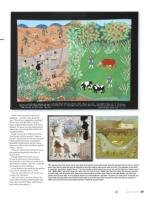
TOP: Janiszew Prison Camp: Esther and her sister Mania were tending cows for another farmer when they discovered they were next to a German
prison camp. When the young boys grew too exhausted to work, they would be taken into the woods to be shot. “The composition in this picture
is remarkable,” says Esther’s daughter Bernice. “It has this incredibly beautiful pastoral scene on one side, and this nightmare of violence on the
other.” ABOVE, RIGHT: “[My brother] Ruven and I swim in the river below our house.” ABOVE, LEFT: Black Sky Falling: After becoming separated
from their family, never to see them again, Esther and her sister wandered to another village. Taking on new Polish identities, they went to the
sheriff’s house to ask for help. “If we are going to pretend to be Yuzha and Marish,” said Esther, “we have to act as they would.” So they did, and
received help. That night, Esther dreamt that her mother pulled her out of the house. When she asked her mother why they were running, her
mother said, “Because the black sky is falling. And when it reaches the ground we’ll die.”
jn
July 13 • 2017
29