

looking back
From the DJN
Davidson
Digital Archive
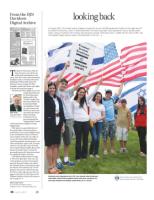
In August 2007, the Frankel Jewish Academy moved into its new 50,000-square-foot facility on the upper level of
the Jewish Community Center in West Bloomfield. The Jewish day high school planted its roots a decade earlier
when a group of parents met to begin discussing the concept. Three years later, in 2000, the first class of 9th- and
10th-graders began taking classes in the basement of the JCC. •
T
he July 10, 1942, issue of the JN
had, of course, news of the war
and Jewish participation in the
same. And, there were some interesting
headlines such as: “Russian Decorates
Hundreds of Thousands of Jews for
Heroism” (story on page 12). But, I
thought I would write about a few light-
er items this week from page 5.
The first item that caught my eye was
a large advertisement
for Freed-Eisemann
Radios sold by the
“World’s Largest Free-
Eisemann Dealer,” the
Economical Radio
and Appliance Dealer
on Cass Avenue and
Peterboro (just south
Mike Smith
of present-day Wayne
Detroit Jewish News
State University)
Foundation Archivist
in Detroit. The ad
was introducing the
“Heppelewhite” model
created by famous designer, George
Hepplewhite.
If the photo is a good indication of
the actual radio, it must have been a
real beauty. In our current digital world,
it also reminded me that, in 1942, the
mass medium of the day was radio. It
was on the home radio that families
could hear popular entertainment, com-
edies and dramas, sports and, of course,
music. It was also the source of world
news and President Franklin Roosevelt’s
famous “Fireside Chats” in which he
personally spoke with Americans about
the significant affairs of the day.
I also liked another feature on page
5: “Our Own Quiz Box.” This was a set
of 10 questions on “Jews In Literature”
asked by Howard Collins, who edited
the Saturday Review of Literature’s popu-
lar column “Your Literary I.Q.” I’m not
going to tell you how I did on the quiz,
but if you want to give it a go, then, see
page 5 in the July 10, 1942, issue on the
William Davidson Archive; the answers
are on page 14. •
Want to learn more?
Go to the DJN Foundation archives,
available for free at www.djnfoundation.org.
46
July 6 • 2017
jn
Celebrating Israel Independence Day in 2011 were students Debbie Wrotslavsky,
Joshua Kahn, Jessica Curhan, Stephanie Curhan, Aaron Goss, Josh Broner and
Jesse Adler. Reprinted from Michigan Jewish History, Vol. 51, Fall 2011.
Historic photos are curated by the
Jewish Historical Society of Michigan.