
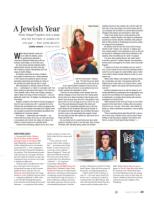

A Jewish Year
Abigail Pogrebin
Writer Abigail Pogrebin took a deep
dive into the heart of Judaism for
one year — then wrote about it.
SUZANNE CHESSLER CONTRIBUTING WRITER
W
riter Abigail Pogrebin usually isn’t
one to settle for sidelines, unless
it’s something like attending a
University of Michigan football game with her
husband, David Shapiro, an Ann Arbor alum.
For more serious interests, Pogrebin prefers
getting directly involved, and that’s what she
did in seeking a deeper understanding of the full
range of Jewish holidays.
As Pogrebin researched the history, traditions
and context of observances for a series published
in The Forward, she resolved to spend a full year
personally experiencing each holiday as it arose on
the calendar and widely describe that in a book.
After participating in unfamiliar rituals for the first
time — submerging in a mikvah in connection with Yom
Kippur, fasting on days beyond Yom Kippur (17th of Tammuz,
Tzom Gedaliah, Tenth of Tevet, Fast of Esther), avoiding a
night of sleep in the study of Torah on Shavuot — she com-
pleted My Jewish Year: 18 Holidays, One Wondering Jew (Fig
Tree Books).
Pogrebin, president of the (Reform) Central Synagogue in
New York and a trustee since 2011, expanded her text by
meeting with representatives from various synagogues and
temples, and she included commentary from religious schol-
ars consulted to provide the informational foundations that
enlightened her immersive outreach.
Her findings — intellectually and emotionally — are
shared with each reader, one-to-one, as if she was having
a conversation with a friend. She relates, for instance, the
details of a seder shared by her extended family.
“I learned how demanding Judaism can be, and I mean
KIDS/YOUNG ADULT
• A young adult book, Choices:
The True Story of One Family’s
Daring Escape to Freedom (Little
Egg Publishing Company) has J.E.
Laufer telling about two overwhelm-
ing experiences — first escaping the
Nazis and later fleeing the Hungarian
Revolution. This fictionalized account
calls attention to a teenage Christian
girl who aided the family’s escape and
emphasizes how one person can make
a significant difference.
• Israeli author and illustrator Paul
Kor, who had to leave France for
Switzerland because of anti-German
graffiti he drew, tells the story of
Flash the Fish (Dial Books for Young
Readers). In the children’s picture book
— originally published in 1990, when
it won the Ben-Yitzhak Illustration
Prize from the Youth Wing of the Israel
Museum — a young silver fish enlists
that in the best sense,” Pogrebin
says. “The fact that we are asked
to mark moments as often as we are
in the Jewish tradition changes the way we look at
our daily lives. We are forced, in a very profound way, to be
mindful, grateful and responsible to others.
“There are so many holidays in this calendar when the
ultimate message is not so much how we’re feeling spiritu-
ally but what we’re doing concretely to help someone who
doesn’t have what we have, who isn’t in the position of privi-
lege we are in or isn’t as happy as we are. That, to me, was
one of the great takeaways throughout this whole year.”
Pogrebin, who occasionally integrated some of the new-
found rituals into her household, discusses the reaction of
her husband and their teenagers, Ben and Molly. Not expect-
ing them to join in, she appreciated their support of what
she was doing and tells about getting the right sound from a
shofar with their help.
Her own family and her Jewish family have been earlier
subjects in Pogrebin’s career. In her first book, Stars of David:
Prominent Jews Talk About Being Jewish, she provided
family members to help a lost
baby whale find her mama and
papa.
• “Feet, what do I need
you for when I have wings to
fly?” — Surrealist artist Frida
Kahlo. “A clear and innocent
conscience fears nothing.” —
Queen Elizabeth I. “Above all,
don’t fear difficult moments.
The best comes from them.” —
scientist Rita Levi Montalcini.
“I dissent.” — U.S. Supreme
Court Justice Ruth Bader
Ginsburg. In Good Night Stories for
Rebel Girls (Timbuktu Labs), Elena
Favilli and Francesca Cavallo feature
100 stories, with glorious illustrations,
of inspiring women throughout his-
tory (without the help of a prince). A
boxer, ballerinas, athletes, activists,
first ladies and more tell true stories
of remarkable girl power. And this
celebrity accounts of how Judaism did or did not enter into
their lives. In her second book, One and the Same: My Life
as an Identical Twin and What I’ve Learned About Everyone’s
Struggle to Be Singular, she personalizes a wider topic.
“I think of My Jewish Year as a lively adventure that’s
accessible,” explains Pogrebin, who began her professional
pursuits as an actress, became a television news producer
(first for PBS and later for 60 Minutes) and turned to writing
for magazines and newspapers.
She believes what the new text covers will be of equal
interest to both “rookies” and “veterans” in religious prac-
tices, wanting readers to be entertained as much as they will
be educated or challenged to think about milestones in the
calendar, which she defines as the “spine” of Judaism.
“I’ve never done anything like this, and I didn’t want it
to feel like a gimmick,” explains Pogrebin, who describes a
feminist seder encouraged by her mother, writer Letty Cottin
Pogrebin.
“I wanted it to be born of something very true, which it
was: my own hunger to know more and understand where I
come from and to assess for myself whether some of what
I was missing I should consider adding to my life in a more
regular way.
“Before every holiday, I was steeped in reading and learn-
ing. I would figure out where I was going to observe this
holiday and try to take notes in my head. At home, I would
write about it, digest it and quickly start learning about the
next one.”
Important realizations had to do with the feeling of com-
munity established by participating with congregations rang-
ing from the very Orthodox to the experimental. The idea
is emphasized in a narrative about dancing with unknown
worshippers on Simchat Torah.
“What surprised me the most and moved me more than I
expected is that when there’s a holiday, others are going to
be there for you,” she says. “Even when I went without my
family to a ritual or observance somewhere, I was not going
to be alone.
“There’s something stirring about the fact that a commu-
nity is there when a holiday arrives, and the value of these
holidays is that they bring us together. That confirms that
there is a sense of family beyond blood relatives.” •
month, a Kickstarter went live to help
fund Volume 2 plus the first season of
the books’ accompanying podcast.
• Motti’s older brother, Gideon, is
only 19 — the same age as Israel. He
knows war is coming and wishes he
could join the army like Gideon. But
when his best friend’s family flees the
country and his brother goes off to
fight, Motti realizes this war isn’t a
game. In The Six-Day Hero (Kar-Ben),
by Tammar Stein, Motti finds hope
in a kind Ethiopian priest, the young
Germans who come to offer help, his
father’s childhood friend from Jordan
and in his grouchy neighbor, Mrs.
Friedburg.
jn
June 29 • 2017
23