

jews d
in
the
100 Years Ago
O
Irwin Cohen
Special to the
Jewish News
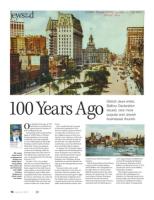
TOP: Looking
toward City Hall
on Woodward and
Michigan from
Cadillac Square.
The big building
left of center is the
posh Ponchartrain
Hotel. RIGHT:
Looking up
Woodward and
Detroit’s skyline
from Canada.
16
ne hundred years ago, in 1917,
Detroit’s Jews wondered and
argued about the number of
Jews residing in the city.
Community leaders estimated the
figure at 35,000. Many in Detroit’s
Jewish population were moving
northward, and many shopkeep-
ers were following the trend up the
Hastings corridor north of Grand
Boulevard. Some were opting to
move as far as 12th Street, about
a mile west of Hastings. (Historic
Hastings Street, the main street of
the early Jewish community in the
city, was demolished for the Chrysler
Freeway, I-75.)
On June 5, 1917, two months
after the U.S. entered World War I,
Detroit’s males between ages 21-30
had to register for the draft. Boys in
senior classes were presented with
their diplomas early to allow them
to graduate before they volunteered
for service. Fort Wayne saw action by
housing battalions of troops, and a
total of 65,000 of the city’s men and
women would serve in the armed
June 22 • 2017
jn
forces.
Jews constituted only 3 percent
of America’s population in 1917.
However, almost 5 percent of those
serving in the armed forces were
Jews. Eighteen percent of the serv-
ing Jews were volunteers, which also
was above the national average. By
the time the war ended almost 18
months later, more than 60 Detroit
Jews would die while in uniform.
In August 1917, the Jewish Legion
was organized by the British govern-
ment. Its purpose was to drive the
Turks, who had joined the Central
Powers (Germany, Austria and
Hungary), out of Palestine. Joseph
Sandweiss was the first Detroiter to
sign up at the Hastings Street recruit-
ing office.
Norman Cottler, who would
become well-known years later for
his Dexter-Davison markets, also
enlisted in the Jewish Legion to fight
for the liberation of Palestine from
the Turkish yoke. Cottler became a
corporal and served in the same bat-
talion with David Ben-Gurion, who
Detroit Jews enlist,
Balfour Declaration
issued, cars more
popular and Jewish
businesses flourish.
would become Israel’s first prime
minister.
British Prime Minister David Lloyd
George and his Foreign Minister
Arthur Balfour were sympathetic to
the right of Jews to return to their
biblical homeland and to the estab-
lishment of a Jewish state. The men
were friends of Chaim Weizmann,
head of the Zionist movement.
Weizmann requested and received a
statement from the British govern-
ment supporting the establishment
of a Jewish homeland in Palestine.
The statement, drafted by Arthur
Balfour, was delivered on Nov. 2, 1917,
and became known as the Balfour
Declaration. It stated:
“His majesty’s government view
with favor the establishment in
Palestine of a National Home for the
Jewish people, and will use their best
endeavors to facilitate the achieve-
ment of this object, it being clearly