

jews d
in
the
continued from page 12
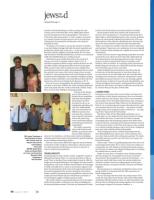
TOP: Geebee Thimotheose of
West Bloomfield and Zipora
Meir of Ramla, Israel, are
Rotarians who share the
same birthplace:
Kerala, India.
BOTTOM: Nissim Moses,
Batzion and Bezalel Eliahu,
all of Israel, and documentary
filmmaker Geebee
Thimotheose of
West Bloomfield.
14
June 15 • 2017
narrative of the Jewish diaspora. India is perhaps the only
country in the world where Jews never suffered from hatred
and anti-Semitism from the local population.” That theme is
at the heart of his documentary. “I want to explore my journey
as a Nasrani Christian trying to discover who I am and where
I belong from the perspective of Indian Jews who today live
primarily in Israel.
“In doing so, it’s my hope to answer the question of whether
it was their Indian heritage that holds the secret ingredient and
perhaps the solution that we all crave — to live in peace and
harmony with our neighbors. Ironically, Ramla, the new sister
club of Geebee’s West Bloomfield Rotary, is home to an estimated
3,500 of the 85,000 Indian Jews residing in Israel.
Christianity’s roots in India date back to the arrival of St.
Thomas, one of the 12 Apostles of Jesus Christ, in 52 C.E.
Christians migrated to Kerala in large numbers between the 4th
and 10th centuries, fleeing persecution in the Persian Empire.
While ancient trade routes are believed to have initially intro-
duced Jewish merchants to India, the predominant theory is that
Jews arrived in two waves. First, and to a lesser extent, as early
as 586 B.C.E., after the destruction of the First Temple in ancient
Jerusalem by the Babylonians. The majority of emigrants seeking
asylum in India would follow more than 600 years later after the
destruction of the Second Temple by the Romans in 70 C.E.
Born out of years of assimilation, the Indian Jewish popula-
tion grew to more than 35,000 in the 1940s, sustaining itself until
most made aliyah after the creation of the State of Israel. Today,
there are fewer than 5,000 Jews remaining in India.
Contrary to the divisive-
ness in other nations, it’s
Ramla’s diverse population
that binds them together.
Ramla Mayor Yoel Lavi
describes his city as “an
immigration-absorbing city
with over 70,000 inhabit-
ants who arrived from 50
different countries. Jews
and Arabs live in harmony
and in peaceful coexistence
side by side, preserving
warm community relations
and reflecting colorful mul-
ticulturalism.”
The Arabic community
alone, both Christian and
Muslim, accounts for more
than one-fifth of Ramla’s
citizenry. It is, therefore, a city that mirrors Geebee’s birthplace
of Kerala and, for that reason, has provided the perfect backdrop
for his ambitious documentary project.
However, what Geebee didn’t know upon his arrival in Ramla,
located just 23 miles northwest of Jerusalem, is that his journey
as a documentarian and Rotarian were about to intersect in
ways he could not have predicted.
TRACING ANCESTRY
In preparing for his trip to Ramla, Geebee sought the counsel of
lifelong friend Nissim Moses, 75, a man he describes as “like an
uncle.” Born in Bombay, Nissim made aliyah to Israel in 1966. He
fought and was injured during the Yom Kippur War. His research
and graduate work at the Technion-Israel Institute of Technology
in Haifa eventually led to a career as an acoustics engineer with
Israel Aircraft Industries (IAI), where he founded and headed up
its acoustics department for 28 years. During his tenure there,
Nissim would be instrumental in securing defense contracts that
would rank Israel behind only the United States and Russia as
the third largest supplier of military goods to India.
Like Geebee, Nissim is a passionate historian. He is the author
of Bene Israel of India, a testimony to his deep and abiding love
for his Jewish Indian ancestry. The book was introduced in Israel
in 2015 at the third national convention of the Jews of India.
For the purpose of this story, Nissim’s role would come in
the form of an introduction to a close friend of his, Kerala-born
Zipora Meir, a retired banking executive who now lives in Ramla.
Zipora, 68, whose family migrated from India in the 1970s, was
the beneficiary of the tolerance afforded the Jews of Kerala. She
shares the same sentiment expressed earlier by Geebee that
“India is one of the rare countries where Jews did not suffer from
anti-Semitism.” Nissim knew she would prove to be an invaluable
link to Geebee’s Indian heritage and a significant resource for his
documentary.
Geebee arrived in Israel to begin filming in July 2016. From the
moment they met, Zipora treated Geebee like a lifelong friend;
their shared passion and deep appreciation for their common
ancestry created an instant bond. Zipora would later recall
fondly in a letter to Geebee: “It is amazing, myself a Jewess from
Kerala, living in Israel and you a Christian from Kerala, living in
the United States, got to know each other.”
Zipora facilitated many introductions for Geebee that led
to interviews for his documentary in more than a dozen cit-
ies across Israel. He met with Indian Jews from all walks of life
including renowned doctors, educators, entrepreneurs, artists
and military personnel. However, it was one meeting, a gather-
ing at the home of Zipora’s 87-year old uncle, Bezalel Eliahu, also
a Kerala immigrant renowned for creating Israel’s first modern
greenhouse, that Geebee and Zipora would learn they had more
in common than just the place of their birth.
A SHARED VISION
During the conversation that ensued, Geebee and Zipora dis-
covered that, to their shared amazement, they were members
of their respective city’s Rotary clubs. Geebee, the immediate
past president of the West Bloomfield Rotary Club, and Zipora,
the current International Affairs Officer for the Ramla Rotary
Club. It was a transformational moment that planted the seeds
of cooperation between the two clubs — the genesis of which
brings us back to the original narrative of this story — the sign-
ing of their “Agreement for Partnership.”
The Rotary clubs of West Bloomfield and Ramla, once a
world apart, are now linked by their shared mission to change
the world for the better. To that end, the clubs are already
exchanging ideas and developing programs that reflect their
common interests, including an international initiative focused
on the needs of today’s youth. Plus, both clubs are also working
on a cultural exchange program where they’ll host a delegation
from each club in Ramla and West Bloomfield.
“We’re looking forward to a fruitful relationship with the
West Bloomfield Rotary,” Zipora says. To the members of her
new sister club she offers this enthusiastic greeting: “We whole-
heartedly welcome you all to our club and to our country, the
holy land of Israel.”
Geebee adds, “There is a gratifying byproduct born out of our
newly forged partnership. We’ve come to learn how similar our
communities are with regards to living harmoniously among a
rich diversity of cultures and religious backgrounds even during
the volatile times in which we live.”
Maybe it’s more than a coincidence then, beshert perhaps,
that this perspective runs parallel to the theme of Geebee’s
documentary that brought him to Israel in the first place — to
learn how nearly 2,600 years earlier the ancient Indian Jews
of Kerala, centuries away from making aliyah, lived in peace
and with tolerance among their Hindu, Christian and Muslim
neighbors.
His documentary is tentatively scheduled for release in the
spring of 2018 to correspond with the 70th anniversary of
Israel’s independence.
We can only hope that from their two small corners of the
world, the steps taken by the Rotary clubs of West Bloomfield
and Ramla will help remind us there are still extraordinary peo-
ple from diverse backgrounds joining together to do extraordi-
nary things to improve the human condition. •
jn
BC