

eretz
Ours
Again!
Editor’s Note: This story
first appeared on the
Israel Defense Forces blog
on May 20, 2012, during
the 45th anniversary of
the Six-Day War.
ANDREW TOBIN
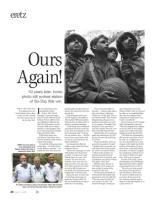
ABOVE: This iconic photo by
press photographer David
Rubinger captured the elation of
regaining the Western Wall.
I
t was the picture seen
around the world.
In June 1967, David
Rubinger, a press photogra-
pher in Israel, followed Israel
Defense Forces soldiers who
were fighting to liberate the
Old City of Jerusalem. At the
Western Wall, three soldiers
posed for a photograph. They
were Tzion Karasenti, Yitzhak
Yifat and Chaim Oshri.
While their names are
not famous, their faces have
become symbols of the reunifi-
cation of Jerusalem.
To mark the 45th anniversary
of that day — the 28th of Iyar
on the Hebrew calendar — we
found the three men from the
The soldiers in Rubinger’s photos: Tzion Karasenti, Yitzhak Yifat and Chaim
Oshri on the Tel Aviv University campus in Ramat Aviv on May 7.
24
June 1 • 2017
jn
DAVID RUBINGER
50 years later, iconic
photo still evokes elation
of Six-Day War win.
photograph and asked them to
share a few memories from the
special day.
Zion Karasenti is 69 years
old. He fought in the Battle of
Ammunition Hill in Jerusalem.
Today he lives in Afula and is a
director and choreographer.
“I had finally been mobilized,
and almost all of the reservists
in my unit were already in com-
bat,” Karasenti said. “I remem-
ber my mother’s fear — and her
tears. I knew our country had
no choice, and I had to do my
duty to defend it.”
On Ammunition Hill, the
soldiers come under fire from
Jordanian forces.
“There was a passage covered
with barbed wire,” Karasenti
recalled. “I jumped on it and
helped others to cross. I felt
no pain. We went into the
trenches. They were not very
deep, but they were quite nar-
row. When someone was hurt,
we had to lift his body over
our heads. The Jordanian army
fought hard to the last man.”
Karasenti, then 24 years old,
was the first paratrooper to
reach the Western Wall. He
did not immediately recognize
where he was standing.
“I saw an Israeli soldier in
the area — I had no idea where
she came from. I asked her,
‘Where am I?’ She said, ‘This is
the Western Wall.’ Then, before
disappearing, she gave me a
postcard and told me to write
to my parents. I thought I had
dreamed it. But years later, I
met this woman. She was a sol-
dier in the IDF Postal Corps.”
Yitzhak Yifat, 69, is a gynecol-
ogist and obstetrician. In 1967,
he was 24 years old and living
in Tel Aviv.
“I had a toothache when we
arrived in Jerusalem,” he said.
“I fought while my mouth was
still numb from local anesthe-
sia. There was hand-to-hand
combat in the trenches on
Ammunition Hill. My best
friend was hit in the back, and
a Jordanian was about to shoot
him again. I shot first.”
Yifat lost many friends in
that battle. Their names are
now etched in stone at the
memorial at the site.
Not long after the Battle of
Ammunition Hill ended, Yifat
prepared to enter the Old City.
“The entry into the Old City
was chaotic,” he said. “We
entered through a small gate
and winded our way to the
Western Wall. I was very moved
by what we accomplished that
day. I am not religious, but I
realized how important it was
for Jews worldwide.”
Born in Yemen in 1944, Chaim
Oshri immigrated to Israel in
1949 and completed his military
service in 1965. He was called
up for reserve duty in the days
leading up to the Six-Day War.
“The battle for Ammunition
Hill was the worst time of war,”
he said. “As a religious Jew, it
was very special for me to par-
ticipate in the battle for the lib-
eration of Jerusalem. We pray
three times a day while facing
Jerusalem. I could not imagine
how magical it would be to see
the Western Wall for the first
time. That was my dream!”
In front of the wall, a press
photographer, David Rubinger,
approached the three soldiers
and pointed his lens at them.
“He told us to look up and
was lying on the ground to
take the photo,” Oshri said.
“It’s just incredibly lucky for
us to have been present at
this historic moment and to
appear in this photograph. It is
a great honor.” •