
for college students by college students
David Project Mission
Offers Diverse Views
commentary
The Political Left
in the Pro-Israel
Conversation
A
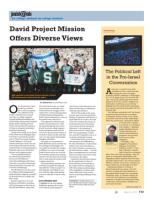
MSU students on the David Project mission to Israel
(Ari Chesterman is third from the right.)
Ari Chesterman } jewish@edu writer
O
ver the past year, I have
worked as a student
intern with an organiza-
tion called the David
Project, which focuses on Israel
advocacy on college campuses
through building friendships and
relationships among various student
groups and by sharing personal
stories and narratives. Its goal is to
develop an integrated and valued
pro-Israel community.
During winter break, as the David
Project intern from Michigan State
University, I was invited to partici-
pate in “Israel Uncovered: Campus
Leaders Mission,” a 10 day, all-
expense paid trip to Israel. The mis-
sion brings Jewish and non-Jewish
student leaders to Israel, giving them
firsthand experience with Israel’s
dynamic and complex society.
I met remarkable individu-
als, representing universities
from across the Midwest —
University of Michigan, Ohio State
University, University of Cincinnati,
Pennsylvania State University and
University of Pittsburgh.
The 39 students on my bus came
from different faith backgrounds,
representing the religious and politi-
cal diversity found on college cam-
puses today.
My prior experiences in Israel
had been with family or traveling
with Jewish groups, so this trip was
dramatically different. Along with
the usual tourist stops, we visited
many eclectic communities and
learned about the struggles of the
region from a variety of perspectives,
including Israeli and Palestinian
leaders representing diverse views of
the small country they live in.
This experience altered my per-
spective of Israel because I could
see Israel through the eyes of non-
Jewish American college students.
Each participant arrived with his
or her own preconceived notions of
what life in Israel was like, and they
were very open about sharing their
thoughts and beliefs.
Every day we were pushed to
think differently and to examine our
lives, feelings and ideologies. We
were asked to consider how similar
or different we were to the people
living in Israel, and to try to see life
from another’s perspective, putting
ourselves into the shoes of an Israeli.
This is what made the mission such
a unique experience.
The extraordinary speakers, our
excellent tour guide, the staff and
especially the “ordinary people” we
met along the way helped us con-
nect with the culture and develop
a sense of what life in Israel is truly
about.
city’s history. What affected me the
most was listening to a Palestinian
Authority representative.
Many of the people in the room
became upset as he described their
feelings of oppression and the lack of
equal rights in the country. He went
so far as to compare the actions of
the Israeli army in the West Bank
to the actions of Nazis during the
Holocaust. As the grandson of
Holocaust survivors, I didn’t believe
that was an appropriate compari-
son, and I felt compelled to say so in
our group setting that evening.
On the other hand, my eyes were
also opened to how difficult life is
for many Palestinians. I realized that
without some sort of resolution to
the current situation, too many peo-
ple will continue to suffer — on both
sides. It strengthened my conviction
that for everyone’s sake, there needs
to be peace in the region.
I joined the David Project Mission
for the opportunity to return to
Israel and share my knowledge of
the country with my college peers.
I left with a deeper understanding
of the multiplicity of cultures that
exists within such a tiny country
and the continuing challenges of the
region. @
EYE-OPENING VISIT
A highlight for me was visiting
Bethlehem, going to the Church
of the Nativity and learning the
Ari Chesterman of Huntington Woods will be a
junior at Michigan State University. He spent a gap
year in Israel on the Young Judaea Year Course
program.
year ago, I wouldn’t have been
surprised to think I would one day
be among the ranks of people
protesting AIPAC’s presence in Washington,
D.C. It is a bigger shock to know that this
year I would be walking past those same
people to enter the country’s biggest U.S.-
Israel policy conference as a pro-Israel
delegate from the political left, advocating
for a cause I previously associated with the
political right.
I first became acquainted with the Jewish
community last summer as a counselor
at Tamarack Camps. Drawn in by Jewish
and Israeli culture and close relationships
within the community, I returned to Detroit
in the fall with a mission
to continue my connection
with Judaism. I attended
weekly Shabbat dinners,
holiday festivities and
Jewish-Israeli fellowship
programs, one of which
led me to an AIPAC
delegation.
Eventually, I was
Jack Mullen
engaged
in the political
jewish@edu writer
dialogue of the Israel-
Palestine conflict. I knew
that I believed in Israel’s
right to exist as a sovereign
state. Even with that knowledge, I was not
ready to compromise ideologically with
Republican AIPAC speakers like Paul Ryan
and Mitch McConnell. I don’t fit the mold of
AIPAC’s centrism, so how do I maintain my
liberal identity as an advocate for Israel?
Expressing interest in J Street, a
liberal Israel advocacy group, met with
criticism of being anti-Israel because of
the organization’s support of a sovereign
Palestinian state. To maintain integrity as
a non-Jew who believes in the equitable
treatment of Israelis and Palestinians alike,
I often feel I must sacrifice credibility as a
pro-Israel advocate.
continued on page 114
jn
May 25 • 2017
113
Scanned image of the page. Keyboard directions: use + to zoom in, - to zoom out, arrow keys to pan inside the viewer.
May 25, 2017 - Image 113
- Resource type:
- Text
- Publication:
- The Detroit Jewish News, 2017-05-25
Disclaimer: Computer generated plain text may have errors. Read more about this.