

jews d
in
the
Reproductive Rights
STACY GITTLEMAN CONTRIBUTING WRITER
JACII puts
together a
panel on
threatened
right to
choose.
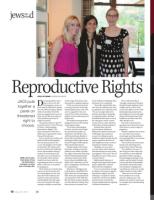
ABOVE: JACII founders:
Brooke Bendix of Royal
Oak, Michal Nodel of
Birmingham and Ariella
Raviv of Farmington Hills.
10
May 25 • 2017
D
iscussing politics these
days is never dry. But
by bringing in stories of
those directly affected by legisla-
tion, the Detroit chapter of Joint
Action Committee II (JACII)
looks to engage Jewish voters in
their 20s and 30s from all parts
of the political spectrum in
political activism.
The group hosted an April 27
panel discussion “From Personal
to Policy: Understanding
Reproductive Rights.” The
panel included an OB/GYN, a
rabbi and a representative from
Planned Parenthood.
First to speak were Jordan and
Michal Nodel of Birmingham.
Now the proud parents of a
1-year-old daughter, the Nodels
in November 2014 discovered
the fetus of their first child had
severe abnormalities during a
routine 20-week ultrasound.
The baby was not expected to
live long after birth, and the
Nodels were faced with the
anguishing decision to carry the
baby to full term or terminate
the pregnancy.
Their decision to end the preg-
nancy was met by the doctors
not with guidance for the next
steps, but with hesitancy and
resistance, they said. Doctors
instead talked about life expec-
tancy and caring for the baby,
waiting or taking a second look
jn
at the image of the fetus in the
ultrasound or adoption options.
“What we witnessed was the
cowering of doctors at this big
hospital [Beaumont], who were
once so supportive, but now
seemed the victims of abortion
politics on the medical practice,”
Jordan said.
The Nodels terminated their
pregnancy, but not after facing
much legal red tape.
“This whole ordeal helped
us frame why the need to fight
for reproductive health is so
important,” said Michal, who,
with friends Brooke Bendix of
Royal Oak and Ariella Raviv of
Farmington Hills, helped found
the JACII chapter following the
2016 presidential election.
Panelists spoke of the misin-
formation swirling around the
political scene about reproduc-
tive rights. Democratic State Rep.
Robert Wittenberg (Oak Park)
and House Democratic Whip
Jeremy Moss (Southfield) also
spoke of the “alarming” pro-life
pieces of legislation currently up
for consideration.
“Abortion is still legal in the
United States,” said OBGYN Dr.
Renee Horowitz of Farmington
Hills. When she attended medi-
cal school from 1976-1980, she,
like her fellow medical students,
received abortion training. Now,
fewer doctors are trained, and
fewer facilities in Michigan allow
abortions to be conducted.
“Terms like ‘partial birth abor-
tion’ are not medical terms, they
are political ones,” Horowitz said.
“We are no longer allowed to
perform abortions in hospitals
or outpatient offices. Planned
Parenthood these days is one of
the only places where women
can go to have a safe, voluntary
termination of their pregnancy.”
Amanda West, director
of government relations at
Planned Parenthood Advocates
of Michigan, also expressed
concern for ebbing women’s
healthcare rights, though she did
express optimism that not all
state legislators want to remove
reproductive health choices.
“Michigan was one of the
very few states where Planned
Parenthood did not come under
investigation,” West said. “Not all
Republicans want to take away a
woman’s choice.”
Rabbi Jennifer Kaluzny of
Temple Israel approached repro-
ductive rights from a liberal,
Reform Jewish standpoint.
“I am very proud how strongly
the Reform movement supports
reproductive rights,” she said,
referring to an April 18 Central
Conference of American Rabbis
statement that censured the
Trump administration’s targeting
of Planned Parenthood.
The CCAR stated that it
“strongly condemned President
Donald Trump’s legislation that
enables states to deny needy
women the right to receive vital
family planning and preventa-
tive healthcare services through
Planned Parenthood and other
healthcare providers that also
offer abortion care.”
Now and in ancient times,
questions arose about the status
of the fetus at various stages of
pregnancy.
“Modern medicine has evolved
in a way that it has created
moral, legal and ethical dilem-
mas unimaginable to our ancient
rabbis,” Kaluzny said.
“Our ancient texts tend to put
the life and well-being of the
mother above that of the fetus.
“Our tradition,” she says, “is
also trying to evolve with mod-
ern medicine and ask difficult
questions: If there is going to
be psychological damage to the
mother and the family if a baby
is born with fetal abnormalities
and will die shortly after birth,
is [termination of pregnancy]
something we need to do so that
neither mother or baby suffer?
“These are never easy ques-
tions and there are no easy
answers,” Kaluzny says, “but
Judaism has much to teach us as
we navigate these heartbreaking
decisions. •