

looking back
From the DJN
Davidson
Digital Archive
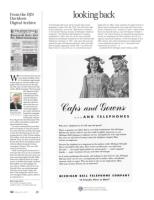
This Michigan Bell want ad for female high-school
graduates is taken from the 1951 Cass Technical High
School yearbook, one of the 1,800 books contained
in the Jewish Historical Society of Michigan’s Yearbook
Collection. The Michigan Bell Telephone Company,
established in 1881, was one of the many licensed
telephone switchboard companies of the American Bell
Telephone Company. In 1951, calls were still primarily
placed through switchboard operators; direct-dial tele-
phones began appearing shortly after. Cass Technical
High School or Cass Tech (as it is commonly known)
dates back to 1862, when students of Capital School in
Detroit were transferred to the newly built Cass Union
School, located on the “outskirts of town” along Grand
River and Second Avenue, near the Masonic Temple in
Detroit. The school became an educational powerhouse,
known for employing the finest teachers and for the
rigorous training of students. In the first decade of the
20 th century, the school relocated and implemented
a new educational direction as a “commercial and
mechanical arts school.” •
Excerpted from Michigan Jewish History, 2004
W
hen was the last time you saw
a newspaper headline where
a U.S. president urged people
to give money to a Jewish welfare cam-
paign? Well, the top story for the May
22, 1942, issue was this: “Roosevelt Asks
Aid for Allied Campaign.” The front page
also featured a letter
from the president
to Rabbi Jonah Wise,
national chairman
of the Jewish Allied
Appeal, in which he
notes that there are
“so many innocent
victims throughout
Mike Smith
the world” and that he
Detroit Jewish News
hoped that campaign
Foundation Archivist
would “meet with an
enthusiastic response
from all generous-hearted people.” This
was a rather extraordinary appeal dur-
ing extraordinary times.
If a reader wanted further proof that
there were plenty of “innocent victims,”
he or she need look no farther than page
2 of the JN, which had reports (by now,
standard fare for 1942) of Nazis stealing
$270 million worth of Jewish property in
Holland. There was also an article about
the pro-Nazi Pierre Lavel taking control
of Jewish affairs during the German
occupation of France. This was a bad
omen for French Jews.
While reviewing the JN issue from 75
years ago, there was no way to avoid the
hard news like that. However, there were
some interesting, lighter bits like Philip
Slomovitz’s editorial about the unique
aspects of Yiddish that largely concludes
that English is an OK language, but
not as fun as Yiddish. And, by the way,
Schmidt’s Beer was advertising again.
This time, its ad touted “Tanks and
Beer.” Until reading the 1942 JN, I just
never thought of tanks, planes and beer
as a threesome. •
Want to learn more?
Go to the DJN Foundation archives,
available for free at www.djnfoundation.org.
62
May 18 • 2017
jn
Historic photos are curated by the
Jewish Historical Society of Michigan.