

Kollek’s foreign press attache,
Nathan began to learn and take
great interest in the different
foodways of Jews from different
communities. She wrote her first
book, The Flavors of Israel, there.
Returning to the U.S., she
worked for New York City Mayors
John Lindsay and Abraham
Beame, and in 1974 she co-
founded the Ninth Avenue Food
Festival. That first year, with
practically no budget, the festi-
val attracted a crowd of about
150,000 people who turned up to
stroll and taste local foods — at
the time, there were many fami-
ly-owned bakeries and shops on
the far West Side.
Since then she has written 10
additional cookbooks, includ-
ing Jewish Cooking in America
and The New American Cooking
— both of which won James
Beard Awards — and, most
recently, Quiches, Kugels and
Couscous: My Search for Jewish
Cooking in France. She hosted a
PBS television series based on
Jewish Cooking in America. Now
74, Nathan lives in Washington,
D.C., and on Martha’s Vineyard.
She and her husband, Allan
Gerson, have three grown chil-
dren.
Her research for this book
of more than 170 recipes took
her beyond kitchens into some
great libraries around the world.
At Yale’s Sterling Memorial
Library, she held the earliest
known “cookbooks” — clay tab-
lets with 44 recipes inscribed,
from about 1700 B.C.E. In
England, she visited the Genizah
Research Unit at Cambridge
University to look into food-relat-
ed ancient documents, and she
found letters about the ancient
spice trade along with some very
early versions of shopping lists.
What has kept Jewish cook-
ing vibrant over the centuries is
the fact that as Jews have moved
from place to place, they have
both been influenced by and
have influenced the food cultures
around them — incorporating
local ingredients and flavors and
passing along their own — to
varying degrees, always with
attention to the distinctions of
kashrut, and the traditions of the
holidays.
She also studied archaeologi-
cal findings and biblical texts for
their references to food of the
times, when bread, wine and
olive oil were, as now, diet main-
stays. King Solomon’s wives, who
came from many lands, would
HOMEMADE HERBED
LABNEH WITH BEETS AND
PUY LENTIL SALAD BOWL
have brought pomegran-
ates, dates, olives and
other foods, along with
varied methods of prepa-
ration.
“Our mythology of
Solomon and his reign
overflows with a table
full of food from the then-
known world,” Nathan
writes in the book’s intro-
duction, which provides a
brief history of Jewish cui-
sine and its evolution.
When people talk about
food, they are often remember-
ing foods they loved; in fact, the
taste of food (along with texture
and smell) is closely linked to
memory. But, says Nathan,
memory and notions of authen-
ticity can be deceiving. Pointing
to a single delicious chocolate
rugelach we are sharing at a
Manhattan cafe, she says, “This
rugelach is probably better than
what our grandmothers might
have made. We now have better
quality ingredients, better choco-
late, better techniques.”
And food looks better these
days. “Traditional Eastern
European cooks didn’t have
much money and they made
food with great care, but the
food wasn’t pretty. Now, we’ve
changed so much. You eat first
with your eyes. There are so
many colors available.”
When I ask if there’s a spiritual
side of food, she says, “I love
doing Shabbat dinner. I’m not
particularly religious, but I like
to bring all these recipes to the
table and have people talk. What
Shana Boltin — an occu-
pational therapist from
Australia and a pickler and
volunteer for Gefiltefest,
London’s annual Jewish
food fair — prepared this
salad for MedVeg, the
kosher vegetarian pop-up
restaurant she runs with an
American friend.
You can buy labneh from
Middle Eastern markets,
Recipes excerpted
from King Solomon’s Table
by Joan Nathan. Copyright
© 2017 by Random House.
Excerpted by permission of
Alfred A. Knopf, a division
of Random House LLC. All
rights reserved. No part of
this excerpt may be repro-
duced or reprinted without
permission in writing from
the publisher.
but it is so easy to make yourself
from yogurt, as long as you allow
an extra 24 hours — the process
is described below. Make this
salad in steps and make it your
own by varying the dish season-
ally and to your own taste. Here
is my take on Shana’s unique and
tasty recipe. Yield: 4 to 6 servings.
Herbed Labneh:
2 cups plain yogurt
½ tsp. salt
1 clove garlic, grated on a
Microplane
1 Tbsp. za’atar, oregano or other
herbs (see note), or crushed chili
1 cup good-quality extra-virgin
olive oil
Beet and Puy Lentil Salad Bowl:
2 large orange and red beets,
trimmed but with a little
stem left on
1 Tbsp. olive oil
Salt and freshly ground pepper
to taste
½ cup rolled oats (not instant)
½ cup dried French lentils,
preferably Puy
½ cup green fresh or frozen
peas, thawed if frozen
¼ cup chopped walnuts
Handful of arugula
6 to 8 herbed labneh balls
(recipe above)
To make the labneh: Put
the yogurt of your choice in a
cheesecloth-lined strainer over a
medium bowl in the refrigerator
overnight. The whey will drip
out of the yogurt, leaving a thick,
creamy labneh. Discard the whey
and scrape the labneh into a
bowl. Then add the salt and gar-
lic and mix well with a spoon.
Put the spices or herb combi-
nation that you choose in a small
bowl. Wet your palms and roll
about 2 Tbsp. of the labneh into
a very soft ball. Gently roll the
ball in your spice or herb mix.
Pour a little olive oil into a
pint-size (or so) glass Mason jar.
Put each ball in the jar, then pour
in oil just to cover. Don’t worry
about wasting the leftover oil —
it makes a great salad dressing.
To make the salad: Preheat
the oven to 350 degrees. Rub the
beets with the olive oil, sprinkle
with salt and pepper and wrap
individually in foil. Bake on a pan
about 1 hour, until tender but
not completely soft when punc-
tured with a fork. Let the beets
cool, then peel. Using a sharp
knife, slice the beets very thinly.
Spread the oats on the pan
and put them in the oven for 10
minutes.
Meanwhile, cook the lentils
in a medium pot with water to
cover and boil for about 30 min-
utes, until cooked but not mushy.
Strain and set aside.
Scatter the lentils, oats, peas,
walnuts and arugula in a serving
bowl. Sprinkle with salt, pepper
and a drizzle of the oil from the
labneh balls, then dot some of
the labneh balls over all, reserv-
ing any leftovers for a later use.
Arrange the beet slices around
the edge of the bowl and serve.
Note: Play around with this
dish, adapting it to the seasons.
In the summer, I like to substi-
tute tomatoes for the beets and
use a combination of fresh herbs
from my garden with the labneh.
If you don’t want to make your
own labneh, you can buy it or
substitute crumbled feta or any
other cheese with this dish.
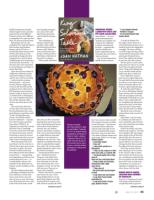
ROMAN RICOTTA CHEESE
CROSTATA WITH CHERRIES
OR CHOCOLATE
From De re Coquinaria (Cookery
and Dining in Imperial Rome),
compiled by Roman gourmet
continued on page 47
continued on page 47
jn
May 18 • 2017
45