

jews d
in
the
BARBARA LEWIS CONTRIBUTING WRITER
PHOTOS BY BRETT MOUNTAIN
O
True Lovingkindness
For 100 years, Hebrew Memorial
has served all in the community.
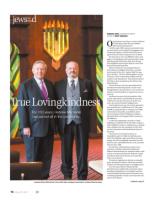
Executive Director Rabbi Boruch Levin and Otto Dube, managing funeral director, of Hebrew Memorial Chapel
16
May 18 • 2017
jn
rganizations more than a century old form
a small club. Earlier this year, Hebrew
Memorial Chapel joined it.
Until the early-20th century, most Jewish funer-
als and burials were handled by synagogues and
landsmannschaften, societies formed by immi-
grants from the same European town or shtetl.
But many Jews were not affiliated with a syna-
gogue or social group, and a good number strug-
gled financially. When they died, their friends
and neighbors had to beg for help to cover their
funeral and burial expenses.
Shlomo Sandweiss was outraged when he
heard about an indigent Detroit Jew who had
been buried in the city’s “potters’ field” for pau-
pers. On May 1, 1916, he called together a group
of 10 men, who resolved there should never be
another such shameful act. They formed Chesed
Shel Emes, then translated as the Hebrew Free
Burial Society.
Chesed shel emes, the term generally used to
describe Jewish burial practices, means “true
lovingkindness,” because there is no way the ben-
eficiary can feel beholden or repay the service in
any way.
Sandweiss became the first president of the
society, which had a membership of more than
1,000 at the end of its first year. In its first two
years, the society buried 65 indigent Jews.
One hundred years ago, the society opened its
first funeral home, at 66 Brewster St. They paid
$5,000 to acquire land for a cemetery at 14 Mile
and Gratiot in Roseville, accessible by street-
car from Detroit. With 27,000 graves, Hebrew
Memorial Park is the largest Jewish cemetery in
the Midwest.
In 1923, the organization moved to a brick
building on Frederick Street that held a chapel, a
hall available for rental, a waiting room, a morgue
and a residence for the caretaker. In 1931, they
moved westward to their final Detroit home on
Joy Road.
It has been in its current location, on
Greenfield south of 11 Mile in Oak Park, since
1964. The building, which seats 600 in the main
chapel, has been completely renovated over the
last five years, said Rabbi Boroch Levin, executive
director since 1986.
By state law, a funeral home cannot own a
cemetery so Hebrew Memorial Chapel and
Hebrew Memorial Park are separate entities, each
with its own board of directors. Both are owned
by Hebrew Benevolent Society, as Chesed Shel
Emes is now known.
The parent organization also has a nonprofit
grave monument business, which has provided
markers for thousands of graves of indigent Jews.
Over the years, Hebrew Memorial Park
absorbed many small Jewish cemeteries whose
founding congregations or immigrant societies
could no longer maintain them. Its board is now
considering whether to take over the Jewish cem-
etery in Port Huron.
continued on page 18