

looking back
Minnie Krugel, born in 1894 in Austria/Hungary, came to Detroit via Toronto around
1920 or 1921. She and her husband, Louis, had three sons, Ben, Max and Harry.
Minnie first opened a cleaning and tailor shop on Brush Street in Detroit before
opening Modern Delicatessen at Fenkel and Holmur in 1924. Louis Krugel died in
1936 in Europe. Minnie and her sons lived above the store.
In the 1930s, she took the unusual step of acquiring a liquor license. She
couldn’t pour liquor, but could sell bottles, which proved to be a very lucrative
business in the 1930s.
Years later, she befriended many members of the Riggers Union and supplied the
members, truckers primarily, with free food. This team of large men, mostly black,
stepped in during the 1967 riots to protect Ma Krugel and her Modern Deli. In
1969, she sold the deli, having managed to provide a living for her and her sons.•
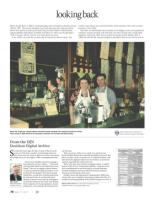
Minnie “Ma” Krugel was a beloved member of the Detroit Jewish community. She is pictured here with her son Max.
Photo courtesy of JHSM, donated to the organization’s collection from the Krugel and Ellstein families.
From the DJN
Davidson Digital Archive
S
eventy-five years ago, the May 15 issue of the JN, as all
issues in 1942, had a number of interesting stories. In
fact, there were too many to allow me to just concentrate
on a single story. So, once again, I offer a smorgasbord of top-
ics.
There was a headline and story on page 2
that related to my last column — “Roosevelt
and Churchill asked to save Polish Jews from
Death.” This was an appeal to these leaders,
as well as prominent religious leaders, to act
to alleviate the rampant starvation among
Polish Jews, as had been recently performed
for starving Greeks. It would seem pretty
obvious to anyone who read the newspapers
in 1942 that wherever the Nazis went during
Mike Smith
Detroit Jewish News
their conquests, the local population, in par-
Foundation Archivist
ticular Jews, were abused and mistreated, to
70
May 11 • 2017
jn
say the least.
There was news of the war. A small, very sad item was
Jewish Welfare Board’s list of Jewish men killed in the war. But,
there was also a story on Jewish ace, Lt. Gabriel Frumkin, who
shot down five Japanese planes on one mission, an outstand-
ing feat, especially this early in the war.
There were also some articles on happier topics. A weekly
feature of the JN was “Community Builders,” a column devot-
ed to contributions to the local area by a Jewish Detroiter.
Swedish immigrant and successful businessman Maurice
Aronsson was honored in this issue.
Finally, I know that Hadassah is celebrating its 100th anni-
versary this year. It might be interesting to know that Mrs. J. E.
Gould was elected president of the Detroit Chapter for 1942. •
Want to learn more? Go to the DJN Foundation archives,
available for free at www.djnfoundation.org.
Historic photos are curated by the
Jewish Historical Society of Michigan.