

spirit
Ilan Wolfson
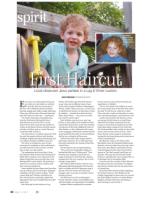
before and after
his first haircut
on Lag b’Omer at
age 3.
First Haircut
Local observant Jews partake in a Lag b’Omer custom.
LOUIS FINKELMAN CONTRIBUTING WRITER
E
very year, tens of thousands of Jews go
up to Meron in the Galilee to celebrate
the 33rd day after the second day of
Passover. The celebration features bonfires,
dancing, singing and, oddly enough, barbering.
Three-year-old boys from all around Israel get
their first haircut on that day — Lag b’Omer.
The Torah commands counting the days
from the first barley offering (the Omer)
until Shavuot (at Leviticus 23:15–16 and
Deuteronomy 16:9). Lag is just the number 33
written in the Hebrew letters with that numeri-
cal value, and then read as a word. This year.
Lag b’Omer falls on May 14.
Ask what there is to celebrate about the 33rd
day and why people celebrate with bonfires,
weddings, singing, dancing and barbering, and
you will get a bouquet of different answers.
The Omer is considered a time of semi-
mourning. No weddings or other celebrations
are held, and observant men don’t cut their
hair or shave as a sign of grief.
The explanation used most often is from
the Talmud, which recounts that thousands of
Rabbi Akiva’s students were wiped out by the
plague during that season because they were
disrespectful to each another. The grieving is
said to be in memory of those students and
their extreme punishment.
Some families far from Meron also have their
sons go without haircuts until age 3. Strangers
unfamiliar with this custom exclaim, “What
a pretty little girl!” Mothers and fathers let
the comment pass or patiently explain that
although he does have beautiful hair, he is defi-
nitely a boy.
Ilan Weiss got his first haircut on Lag
42
May 11 • 2017
jn
b’Omer. His brothers got their first haircuts
at age 3 also, but at different times of year.
Their mother, Jordana Wolfson of Huntington
Woods, recalls, “Many years ago, 11 to be exact,
we did Ilan’s first haircut on Lag b’Omer. A fam-
ily tradition — handed down from the boys’
father, David Weiss — was not to cut a boy’s
hair until he reaches age 3.”
Ilan’s birthday came out on or near Lag
b’Omer, so they added in the tradition of mak-
ing that first haircut then. At the time, Jordana
was director of the Early Childhood Center at
Adat Shalom, so they celebrated with a party
at the synagogue with friends, relatives and the
school staff. Jeff, the barber at Lincoln Barbers,
did the hair-cutting for all three sons.
All three boys felt a little strange without
their long, curly locks. For a while afterward,
they kept reaching for the strands of hair that
weren’t there.
But the haircuts also transformed them.
“They went from looking like toddlers to
looking like little boys,” Wolfson said. “Their
behavior also changed to match the new
image. Wearing new short hair like a big boy
changed them the way wearing a suit to work
changes young adults.”
One of Ilan’s older brothers, when he was a
fifth-grader, liked photographs of the look he
had as a toddler and let his hair grow long. It
did not work. The texture of his hair had
changed, and it never got to look like it did in
his baby pictures.
The three boys now live in Huntington
Woods with their mother and stepfather and
with their father and stepmother in Southfield.
Jordana Wolfson explained the rationale
for the custom at each of these first haircuts
(upshirinish, in Yiddish).
“We try to be gentle with children. It resem-
bles not pruning a tree for the first three years,”
she said. “Let the boy be a baby for a while.
Then, when he is ready, we bring him to transi-
tion to Jewish learning in a more intensive way.”
Another local mother, Itty Shemtov, whose
son also got his first haircut on Lag b’Omer,
adds that the Chabad community sees the
custom as more about leaving the peyot (side-
locks) than about cutting the rest of the hair.
The Torah prohibits close cutting of a boy’s hair
at the corner in front of the ears (Lev. 19:27).
When the boy is old enough to understand,
leaving this hair long demonstrates observance
of that commandment.
Itty Shemtov works at The Shul in West
Bloomfield, where her husband, Rabbi Kasriel
Shemtov, serves as rabbi. Four years ago, when
their twins, Meir Shlomo and Rochel, turned
3, Rochel began the first snip of her brother’s
haircut at The Shul’s annual Lag b’Omer cel-
ebration. This year, the Great Jewish Family
Festival, is scheduled for 5 p.m. Sunday, May 14,
at Heritage Park in Farmington Hills.
It was not just the occasion of Meir Shlomo’s
first haircut. He also received his own kippah
and tzitzit to initiate him into the observances
of a Jewish boy.
Rochel had other honors besides beginning
her brother’s haircut. That Shabbat she lit
candles, beginning her observances as a Jewish
girl. Both children received a wooden Hebrew
alphabet, drizzled with honey for licking, to
start learning to read sweetly. •