

jews d
in
the
continued from page 18
“Seventy-
five years of
progressive
ideas, inclusive
policies and
innovative
thinking created
and developed
Temple Israel.”
— Dr. Edward Royal
Temple Israel Clergy
Josh Bennett
Marla Hornsten
Jennifer Kaluzny
Jennifer Lader
Harold Loss
Neil Michaels
Michael Smolash
Paul Yedwab
Rabbi Paul Yedwab, as “the smallest large synagogue in the world,”
the 12,000 members who call the temple their spiritual home — and
that’s one out of every 100 Reform Jews in the world — have much
to celebrate.
“Seventy-five years of progressive ideas, inclusive policies and
innovative thinking created and developed Temple Israel,” wrote
President Dr. Edward Royal in an August 2016 program document-
ing contributions from past presidents at the beginning of a year of
anniversary celebrations.
“It now stands proudly as the largest, most forward-thinking and
energized Reform congregation in the world. Rabbi Leon Fram
founded Temple Israel as his Miracle Congregation. And now, look-
ing back, I think even he would have been incredibly surprised and
proud of the true miracle it has become,” Royal wrote.
Temple Israel remains on the cutting edge of liberal Judaism even
as it continues to revive and renew Jewish traditions such as a daily
minyan, midnight Selichot services prior to the High Holidays and
the first Reform congregation in the country to house a mikvah.
From its level playing field absent a hierarchical clergy structure
to its engaging services and religious and non-religious activities
that bring hundreds of people through its doors each week, the
congregation, Paul Yedwab said, is large yet nimble and creative and
not stifling for clergy and lay leader alike. It is rare in its history for
clergy not to stay for decades and not to feel vital and valued well
into their 70s and 80s.
Along with Yedwab’s siddur, Cantors Michael Smolash and Neil
Michaels work to incorporate the spiritual joy of music and singing
into weekly services. On a summer Friday evening, it is not unusual
to find 1,000 worshippers attending Shabbat Under the Stars.
“We understand music is what moves our members, a vision
that our cantors actualize so very beautifully,” Yedwab said. “We
have strived to transform ‘tefillah’ worship services through song
and interaction into truly joyful, spiritually uplifting and enjoyable
events. From Shabbat Unplugged to our outdoor services to our
Purim Palooza spiel, we are always mindful we have to put forward
an experience we ourselves would leave our own homes to attend
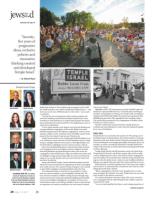
CLOCKWISE FROM TOP: An outdoor
concert at Temple Israel. Torahs are
carried from the Manderson building
to the new West Bloomfield sanctuary.
Rabbi Leon Fram at the construction
site for the Detroit building in 1948.
were we not clergy.”
Highlights of this 75th anniversary year have included a gala cel-
ebration in April and Mitzvah 613, a 15-month project inviting all
members to participate in writing a new Torah scroll. According to
Temple Israel CEO David Tisdale, the project has raised more than
$500,000 and more than 700 congregants have inscribed a letter.
The scroll will be presented to the congregation at Shabbat Under
the Stars at 7:30 p.m. Sept. 8.
The first scroll written and presented for Temple Israel was
scribed in pre-state Palestine in a time when the outlook for global
Jewry was at its bleakest.
EARLY DAYS
Temple Israel was conceived in the summer of 1941, during one of
the darkest times in Jewish history. The earliest articles covering its
formation in the now-defunct Jewish Chronicle are juxtaposed with
articles detailing the increasingly grim plight of European Jewry. For
example, an article covering the dedication of Temple Israel’s first
Torah scroll ran beside an article about Nazis burning Jewish books
in Vilna, Lithuania.
Temple Israel started with 600 members, many who broke from
Temple Beth El, Detroit’s only Reform temple, after it did not offer
a senior rabbinical post to Fram, who had served the congregation
since the 1920s. It was said that Fram, with his strong Zionistic lean-
ings as well as his desire to see a return to more tradition in Reform
Judaism, was ahead of his time and a bit controversial for his views.
Rabbi Harold Loss further explained how Fram chose the temple’s
name and how it represented his commitment and vision for estab-
lishing the Jewish State of Israel.
“Many congregations chose the name Temple Israel as a state-
ment of support for Zionism,” Loss said. “Rabbi Fram was one of the
early Zionists in the Reform movement.”
At a solemn dedication ceremony in July 1941, Fram vowed the
new congregation that he called Temple Israel would be a place to
nurture Jewish youth.
“I am very much gratified that there is such a large proportion of
continued on page 22
20
May 11 • 2017
jn